
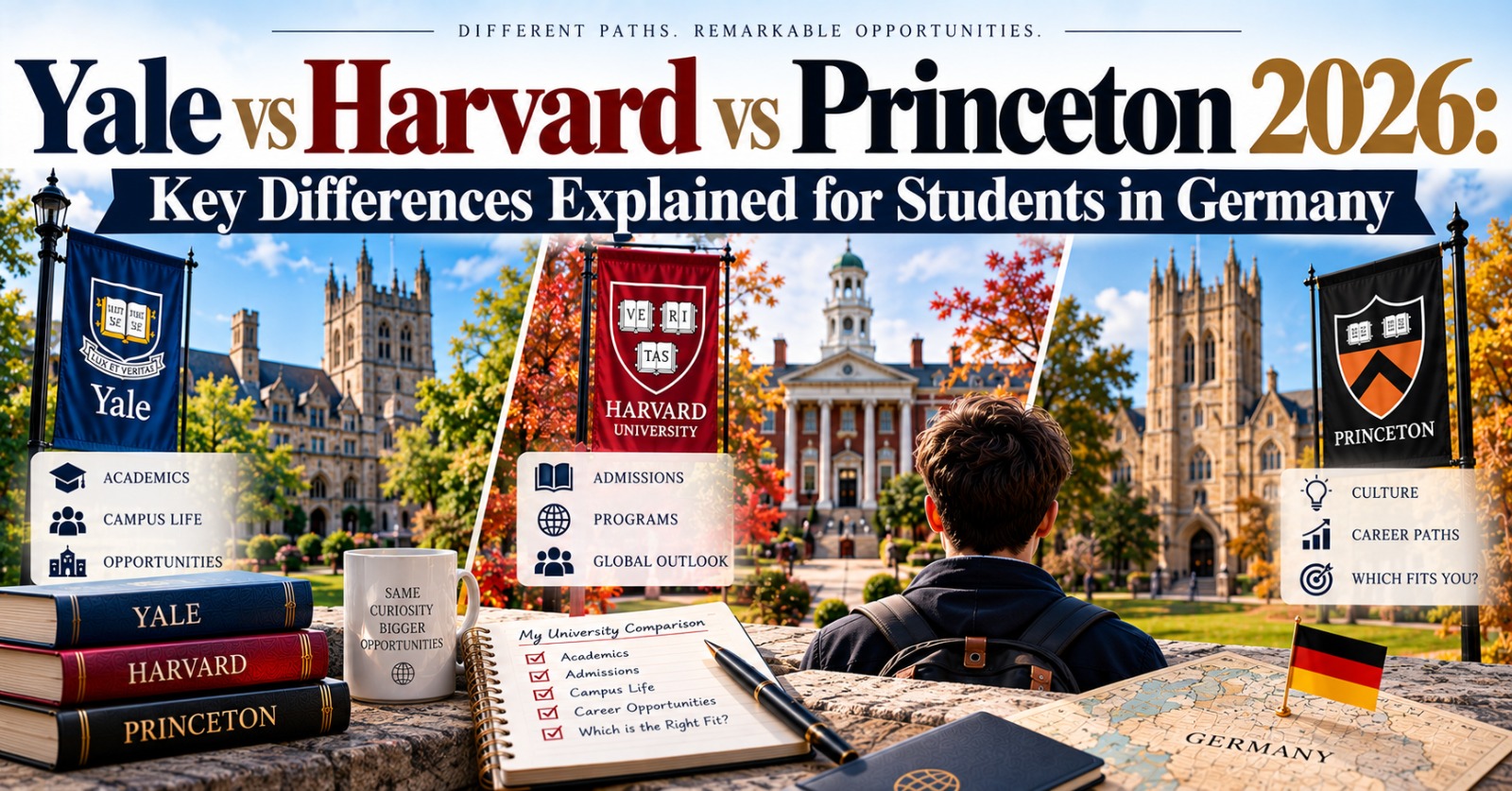
Harvard. Yale. Princeton. Three names that collectively represent the peak of American higher education, and that, to many applicants outside the US, appear so similar as to be almost interchangeable. They are not. These are three meaningfully different universities with different cultures, different strengths, and different ways of shaping the people who attend them.
If you are deciding which of these three to apply to, or which to choose first, since you can only apply Early to one, the question deserves a genuine answer, not a brand ranking. This guide gives you one.
For students in Germany, understanding these differences is only one part of building a competitive US university application. Your university list, academic profile, extracurricular activities, essays, recommendations, and application strategy all need to work together.
Key Facts at a Glance
| University | Location | Undergraduate Students | Founded | Approx. Acceptance Rate |
| Harvard | Cambridge, MA | ~7,000 | 1636 | ~3.6% |
| Yale | New Haven, CT | ~6,500 | 1701 | ~3.7% |
| Princeton | Princeton, NJ | ~5,500 | 1746 | ~3.7% |
Location and Campus Life
Harvard: Cambridge and the Boston Energy
Harvard sits in Cambridge, Massachusetts, directly across the river from Boston. The city is vibrant, deeply academic, and extraordinarily dense with universities, research institutions, and cultural offerings. MIT, Tufts, Boston University, and Emerson are all within walking distance or a short subway ride. Cambridge is one of the most intellectually concentrated urban environments in the world.
The Harvard campus is large, architecturally historic, and varied, with the Yard at its centre, multiple museums, libraries, and a life that extends well beyond the classroom. Proximity to Boston means genuine urban escape is always accessible.
Yale: New Haven, Character and Complexity
Yale is located in New Haven, Connecticut, a city with a complicated reputation. New Haven is not Cambridge: it has economic and social challenges that border directly on the campus. What this means for Yale students is that many engage deeply with the city community, and civic engagement is a genuine element of institutional culture rather than simply a brochure talking point.
The Yale campus itself is Gothic, enclosed, and strikingly beautiful, from the architectural detailing of the residential colleges to the Sterling Memorial Library, which resembles a cathedral. Campus life is intense and inward-facing. Yale has one of the most vibrant arts scenes among major undergraduate research universities in the US.
Princeton: The Perfect Campus
Princeton sits in Princeton, New Jersey, a small, prosperous town positioned between New York City and Philadelphia. The campus is widely considered one of the most beautiful in the United States, spacious, historically layered, and characterised by a quietness that larger universities rarely achieve. Princeton is not an urban experience, so anyone seeking city life needs to travel.
This means social life at Princeton is concentrated almost entirely on campus. Eating clubs, sports, student organisations, and social activity are all tightly campus-centred. For focused, intellectually inward-looking students, this can be ideal. For applicants who seek urban energy and off-campus exploration as part of their university experience, it may feel limiting.
Academic Culture and Curriculum
Harvard: Breadth, Freedom, and Massive Infrastructure
Harvard has an extraordinary concentration of academic resources and research opportunities. It is a research university in a deep, structural sense. Graduate Schools of Medicine, Law, Business, and Public Policy are present within the broader Harvard ecosystem and create an intellectually networked environment that undergraduates can draw from.
The Harvard undergraduate curriculum operates on a Concentration system, analogous to a major, plus General Education Requirements across broad knowledge domains. Academic freedom is substantial, allowing students to explore widely.
The risk in a system this large is invisibility. It is possible to pass through Harvard without deep intellectual engagement if you do not actively seek opportunities, build relationships, and take advantage of the university’s resources.
Yale: Deep Humanities and Strong Ensemble Thinking
Yale has a particularly strong humanities culture, including literature, history, art history, philosophy, and theatre. Its graduate and professional arts programmes are highly regarded, while the breadth of creative and artistic programmes available to undergraduates is a major part of Yale’s identity.
This does not make Yale weak in STEM. It is not, by any measure. However, the institutional culture often tilts toward synthesis, interpretation, and expression.
If you are an analytical thinker who also writes, performs, composes, or works visually, Yale may be your natural environment.
Princeton: Undergraduate Focus and Research Depth
Princeton does not have undergraduate business or law schools, and its academic structure places a particularly strong emphasis on undergraduate education. This creates an environment where direct interaction between undergraduates and leading scholars can be a defining part of the academic experience.
This focus is especially visible in Princeton seminars and research opportunities. Princeton is particularly renowned for mathematics, physics, philosophy, and public policy through the School of Public and International Affairs.
For analytically rigorous and theoretically minded applicants, Princeton can be an especially strong choice.
The Princeton Senior Thesis
A defining feature of Princeton’s undergraduate education is the Senior Thesis. Students in many programmes complete a substantial piece of independent research that serves as a capstone to their undergraduate education.
For many students, the thesis becomes one of the most formative academic experiences of their university career. For applicants who want genuine research depth at the undergraduate level, this feature distinguishes Princeton from many peer institutions.
The Residential College System: Yale’s Distinctive Community
Yale is divided into 14 Residential Colleges, each with its own dining hall, library, athletic facilities, and social spaces. Students spend all four years connected to their college.
This creates an internal community that functions as a home within the larger university. Friendships, rituals, traditions, and identity become anchored to a specific residential community.
Harvard has a similar House system, with 12 Houses, but freshmen spend their first year in the Yard before receiving their House assignments. Princeton also has residential colleges, although its system operates differently from Yale’s model.
The depth of community that Yale’s system produces across all four years is genuinely distinctive and difficult to replicate at peer institutions.
If community, close friendships, and a “home within a university” are decisive factors for you, Yale has a major advantage.
Early Application: REA Rules for All Three
Harvard, Yale, and Princeton all operate Restrictive Early Action, commonly abbreviated as REA.
This means applicants can generally apply Early to only one of these three institutions and cannot simultaneously apply Early to other private universities under conflicting early application plans.
Public universities, such as UC Berkeley, and international universities, such as Oxford and LSE, may operate under different application rules. Students should always check the current requirements of each institution before submitting applications.
The decision of which university to use for your REA application is one of the most important strategic decisions in the application process.
Students who want to understand the differences between Early Action, Early Decision, and Restrictive Early Action can also read ARC Consultancy’s Early Action vs Early Decision guide for students applying from Germany.
It should be based primarily on genuine preference, academic fit, personal priorities, and application readiness, rather than attempting to calculate tiny differences in admission odds.
Which School Is Right for You?
Choose Harvard If…
- You thrive on the density and energy of an urban academic environment and want Boston accessible.
- You want proximity and synergy with other elite institutions and research ecosystems.
- You know you will actively build your own network and pursue opportunities rather than waiting for them.
- Research infrastructure, graduate school connections, and interdisciplinary depth are priorities.
- You value having access to a very broad range of academic and extracurricular opportunities.
Choose Yale If…
- Art, theatre, music, literature, or interdisciplinary creative work is central to your identity, not supplementary.
- You depend on close community and value the residential college system.
- Civic engagement and connection to the surrounding community are important values for you.
- You want a balanced arts and sciences environment with a strong residential identity.
- You prefer a university where traditions, residential communities, and student culture play a major role in daily life.
Choose Princeton If…
- You seek deep, focused intellectual immersion and want the Senior Thesis as your capstone.
- You are interested in mathematics, physics, theoretical computer science, philosophy, or public policy.
- You prefer a quieter, campus-centred lifestyle with less urban distraction.
- Direct faculty interaction at the undergraduate level is one of the most important factors in your decision.
- You want a university where undergraduate education and independent research receive exceptional attention.
Admissions Counselling and University Selection
For students in Germany, choosing between Harvard, Yale, and Princeton should be part of a broader US university application strategy. Factors such as academic profile, extracurricular activities, essays, testing requirements, financial considerations, application timelines, and personal fit should all be considered.
ARC Consultancy provides university admissions consulting for students in Germany, covering university selection, profile building, essay brainstorming, recommendation strategy, interview preparation, and application planning.
For students who are still deciding which universities should be on their list, ARC also provides guidance on university selection and building a balanced university list.
For personalised admissions support and university selection guidance, see:
Admissions Counselling & University Selection
Further Reading
- Ivy League Acceptance Rates 2026: What the Numbers Really Mean
- Early Action vs Early Decision: Strategy Guide for Germany
- Harvard Supplemental Essays 2026 to 2027: All Prompts and Strategies
- Recommendation Letters for University Applications
Final Takeaway
Harvard, Yale, and Princeton are not interchangeable versions of the same university. Harvard is especially compelling for students who want breadth, research infrastructure, and access to a major academic ecosystem. Yale stands out for community, residential life, humanities, and the arts. Princeton is particularly attractive to students seeking focused undergraduate education, close faculty interaction, and independent research.
For students in Germany, the best choice is therefore not necessarily the university with the strongest global brand. It is the institution whose academic culture, campus environment, community, and opportunities align most closely with the person you want to become.
The strongest application strategy starts with understanding that distinction before deciding where to apply Early. Students who want personalised support can explore ARC Consultancy’s university admissions consulting for guidance throughout the application process.
Frequently Asked Questions
What Is the Main Difference Between Harvard, Yale, and Princeton?
The biggest differences are location, atmosphere, academic culture, and undergraduate experience.
Harvard is based in Cambridge, Massachusetts, and offers a large, research-intensive environment with access to the wider Boston academic ecosystem.
Yale is located in New Haven, Connecticut, and is particularly known for its residential college system, strong humanities and arts culture, and close-knit campus environment.
Princeton is located in Princeton, New Jersey, and is particularly focused on undergraduate education, independent research, and a campus-centred academic experience.
Is Harvard or Yale Better for Undergraduate Students?
There is no universally better option. The right choice depends on your academic interests, preferred environment, learning style, and personal priorities.
Princeton and Yale can feel particularly undergraduate-focused because of their institutional structures and campus cultures. Harvard, meanwhile, provides exceptionally broad research infrastructure and access to a large academic ecosystem.
Can I Apply Early to Harvard, Yale, and Princeton?
No. Harvard, Yale, and Princeton use Restrictive Early Action. Applicants generally cannot submit Early applications to all three simultaneously.
If one of these universities is your top Early choice, you should carefully review its current REA rules before applying.
For a more detailed explanation of Early Action, Early Decision, and REA, see ARC Consultancy’s Early Action vs Early Decision guide.
What Is Yale’s Residential College System?
Yale has 14 residential colleges that provide students with a smaller community within the larger university.
Each college has its own dining facilities, social spaces, traditions, and other resources. Students remain affiliated with their residential college throughout their undergraduate years.
This structure can create strong relationships and a sense of belonging that is central to the Yale experience.
Which of the Three Is Best for STEM?
All three universities offer outstanding STEM opportunities.
Princeton is particularly well known for mathematics and physics and provides a highly focused undergraduate research environment.
Harvard offers extensive research infrastructure and access to a broad network of scientific and professional resources.
Yale also provides excellent STEM programmes while maintaining a particularly strong institutional identity around the humanities, arts, and interdisciplinary study.
The best choice depends on your specific field, research interests, preferred teaching environment, and long-term goals.