
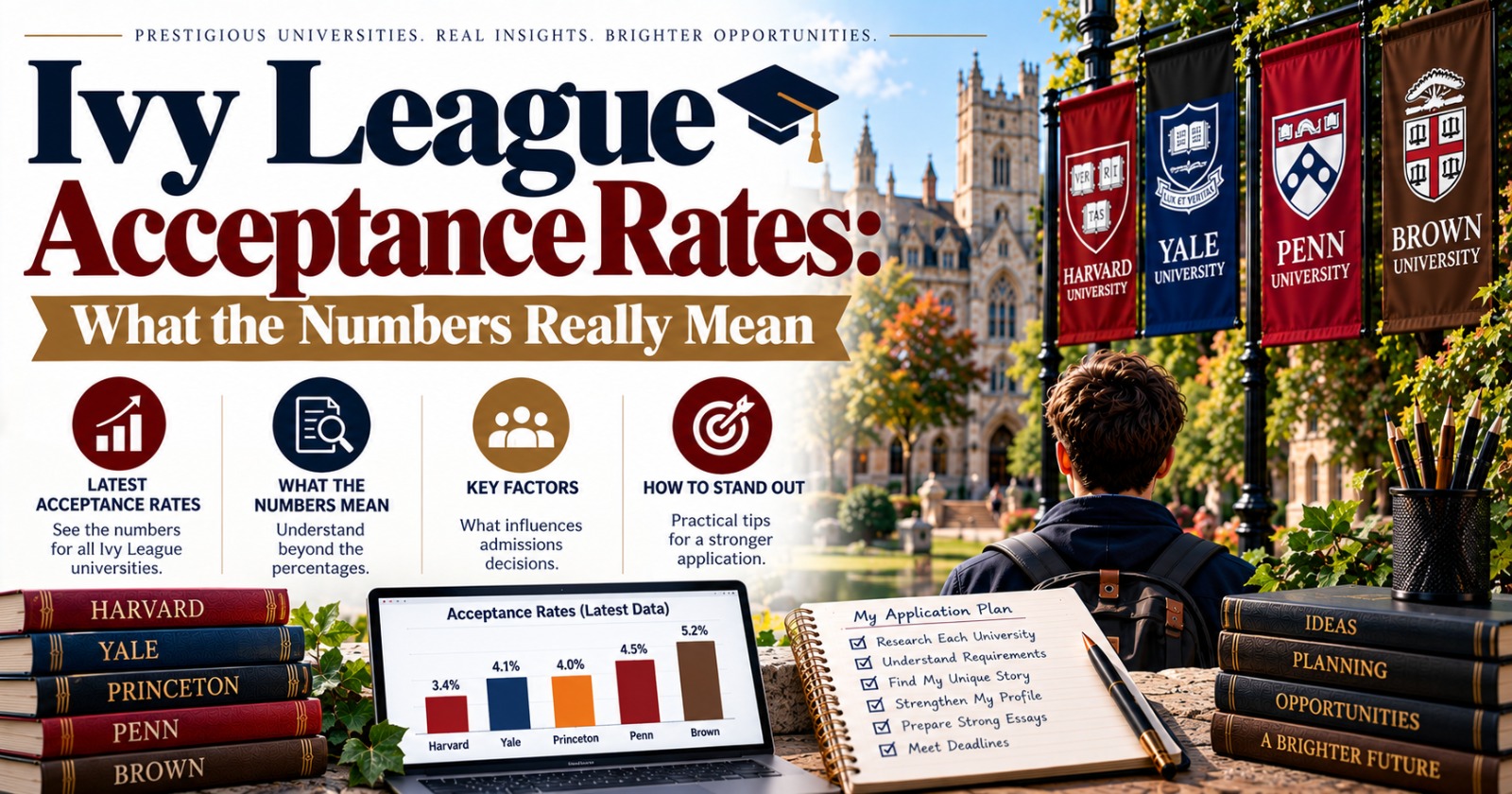
3.6%. 4.0%. 4.7%. Ivy League acceptance rates have burrowed deep into collective consciousness and produce, in many students applying from Germany, either paralysing anxiety or premature resignation. What they rarely produce is an accurate read of any individual applicant’s actual chances.
This guide explains how to read Ivy League acceptance rates honestly, what differences exist between the eight institutions, how international applicants are positioned in these pools, and why a well prepared student from Germany is almost certainly underestimating their chances by reading the headline number and stopping there.
Current Acceptance Rates for All 8 Ivy League Universities
The figures below reflect the Class of 2029, enrolled in autumn 2025, which represents the most recently published data referenced in this article. Figures for the Class of 2030 from the 2025 to 2026 application cycle should be checked against each university’s latest official admissions data.
| Ivy League University | Approx. Acceptance Rate | Approx. Applicants |
| Harvard University | ~3.6% | ~57,000 |
| Yale University | ~3.7% | ~57,000 |
| Princeton University | ~3.7% | ~49,000 |
| Columbia University | ~3.9% | ~60,000 |
| Penn (UPenn) | ~5.9% | ~50,000 |
| Brown University | ~5.2% | ~50,000 |
| Dartmouth College | ~6.2% | ~33,000 |
| Cornell University | ~7.4% | ~67,000 |
Note: These figures can change annually. Applicant volumes have continued rising in recent years, partly driven by changes in testing policies and the growing accessibility of US university applications. This has further compressed acceptance rates at many highly selective institutions.
Why the Overall Acceptance Rate Misleads You
The Rate Includes Every Applicant, Including the Least Competitive
The overall acceptance rate is calculated across every applicant, including students who had little realistic prospect of admission. Students with significantly below average academic profiles, incomplete applications, applicants who submitted without meaningful preparation, and students whose profiles were poorly aligned with a university are all included in the denominator.
If you approach your application seriously with competitive grades, strong test scores, carefully crafted essays, substantive recommendations, and a coherent extracurricular profile, you are competing within a much more relevant group of genuinely qualified applicants.
Your individual chances cannot be calculated simply by applying the university’s overall acceptance rate to your profile.
The Early Decision and Early Action Shift
A significant portion of each class can be filled during an Early application round. Columbia’s Early Decision acceptance rate in 2025 was approximately 17%, compared with an overall rate of around 3.9%. Harvard’s Restrictive Early Action rate has historically been higher than its Regular Decision rate.
The Regular Decision applicant pool therefore competes for the remaining places after Early applicants have been admitted.
This means that application timing can influence strategy. Students who can make a genuine commitment to their first choice should carefully evaluate whether an Early application is appropriate.
International Applicants Compete in a Different Context
International applicants face additional considerations because universities are building globally diverse classes while also evaluating students within their educational and geographic contexts.
The effective acceptance rate for international applicants can be lower than the overall institutional rate. However, there is no single universal international acceptance rate that applies across all eight Ivy League universities.
Rather than assuming that an international applicant automatically has a fixed percentage chance, students should focus on academic preparation, school context, extracurricular distinction, essays, recommendations, and how convincingly their application explains what they would contribute to the university.
What Acceptance Rates Actually Tell You
Signal 1: The Applicant Pool Has Grown Faster Than Class Size
Ivy League undergraduate classes have generally grown much more slowly than application volumes.
Harvard, for example, enrolls approximately 1,600 undergraduates per year, while Princeton enrolls around 1,300. Meanwhile, application volumes at highly selective universities have grown dramatically over the past two decades.
The declining acceptance rate therefore reflects not only institutional selectivity but also a much larger and more global applicant market.
Signal 2: Geographic Context Matters
Geographic and international diversity can play an important role in shaping an incoming class.
A strong applicant from Germany with a distinctive academic and extracurricular profile can provide a perspective different from that of students from heavily represented US regions. Your educational context, experiences within the German school system, cultural perspective, and intellectual interests can all help admissions officers understand your application.
Being from Germany is therefore not inherently a disadvantage. What matters is how effectively your application communicates your individual context and achievements.
Signal 3: Not All Places Are Openly Available
University admissions are influenced by institutional priorities and class composition.
Different universities may consider factors such as recruited athletes, family connections, institutional priorities, academic programmes, geographic diversity, and other characteristics when constructing an incoming class.
This means that the headline acceptance rate does not represent a perfectly equal probability for every applicant.
For an international applicant without a particular institutional priority, the most useful approach is to focus on building the strongest possible application rather than trying to reverse engineer another applicant’s admissions advantage.
The Eight Schools in Detail: What Distinguishes Each?
Harvard, Yale, and Princeton
Harvard, Yale, and Princeton consistently rank among the most selective universities in the Ivy League.
They combine enormous global recognition with relatively small undergraduate classes and extremely large applicant pools.
For applicants without a special institutional advantage, these universities should be treated as high reach schools even when the student has exceptional grades and test scores.
Academic excellence is necessary but not sufficient. Successful applications generally require a compelling combination of intellectual curiosity, extracurricular impact, personal qualities, recommendations, and highly specific essays.
Columbia and Penn
Columbia and Penn offer distinctive urban environments and attract students with a wide range of academic interests.
Columbia’s Core Curriculum is one of its most recognisable academic features, while Penn is particularly known for its professional and interdisciplinary opportunities, including the Wharton School.
Their acceptance rates remain highly competitive, so applicants should avoid choosing either university simply because its published rate appears marginally higher than another Ivy’s.
Brown and Dartmouth
Brown is particularly known for its Open Curriculum, which appeals to students who want substantial freedom to shape their academic programme.
Dartmouth is the smallest Ivy League institution by undergraduate enrolment and is known for its close community, residential experience, and rural setting.
Both universities can appeal to students who value a more personal undergraduate environment. Their somewhat higher acceptance rates do not make them easy admissions targets, however.
Cornell
Cornell has the highest published acceptance rate among the eight Ivy League universities in the figures used in this article and also has the largest undergraduate population.
Despite this, Cornell remains extremely selective.
Its strengths across engineering, computer science, natural sciences, architecture, agriculture, and other disciplines make it particularly attractive to STEM focused applicants.
For students from Germany interested in technical subjects, Cornell can therefore be an especially relevant Ivy League option, although it should still be treated as highly competitive.
Early Decision and the Strategic Advantage
One of the most significant strategic decisions available to applicants is choosing the appropriate application round.
Early Decision is a binding application option at participating universities. If admitted and the student follows through with the agreement, the student is expected to enroll.
Historical and reported Early Decision rates can look substantially higher than overall acceptance rates:
- Columbia ED: ~17% vs. overall ~3.9%
- Penn ED: ~20% vs. overall ~5.9%
- Brown ED: ~15% vs. overall ~5.2%
- Dartmouth ED: ~20% vs. overall ~6.2%
However, these figures should not be interpreted as meaning that an ordinary applicant automatically has a 15% to 20% chance of admission through Early Decision.
Early pools can differ substantially from Regular Decision pools, and universities may use Early rounds to meet particular institutional priorities.
For applicants who are genuinely certain about their first choice and can manage the financial implications, Early Decision can be an important strategic option.
The key condition is genuine certainty. Early Decision is binding, so students should understand the commitment and financial aid implications before applying.
What This Means for Students Applying from Germany
Applicants from Germany enter the US university admissions process with several potential strengths.
The Abitur is an internationally recognised qualification, and the German educational system can provide students with strong analytical and academic preparation.
German applicants may also bring experiences, academic interests, cultural perspectives, and extracurricular activities that help distinguish them within a global applicant pool.
The acceptance rates are real, and they are extremely low. But they are not a personal verdict.
A strong applicant should think beyond the headline percentage. Competitive academic performance, rigorous coursework, appropriate testing, meaningful extracurricular involvement, compelling essays, substantive recommendation letters, and a coherent application strategy all matter.
Students should also build a balanced university list rather than applying exclusively to Ivy League institutions.
Admissions Counselling
Students looking for personalised support can explore admissions counselling with ARC Consultancy for guidance on building a competitive US university application strategy.
Further Reading
- Early Action vs Early Decision: Strategy Guide for Germany
- SAT for the Ivy League 2026: What Students in Germany Need to Know
- Common App Personal Statement 2026 to 2027: Complete Guide
Final Takeaway
Ivy League acceptance rates are useful for understanding how competitive these universities have become, but they should never become the foundation of your entire admissions strategy.
A 3.6% overall acceptance rate does not mean that every applicant has exactly a 3.6% chance. It is a statistical summary of a huge and diverse applicant pool.
For students applying from Germany, the better question is not simply “What is the Ivy League acceptance rate?” but “How competitive is my profile, and which universities are the best fit for my academic and personal goals?”
That shift in perspective can turn an intimidating percentage into a much more practical application strategy.
Frequently Asked Questions
What Is Harvard’s Acceptance Rate in 2026?
The figures used in this article put Harvard’s Class of 2029 acceptance rate at approximately 3.6%. Students should consult Harvard’s latest official admissions data for the newest class because acceptance rates can change from year to year.
Which Ivy League University Has the Highest Acceptance Rate?
Based on the figures used in this article, Cornell has the highest acceptance rate at approximately 7.4%, followed by Dartmouth at approximately 6.2%, Penn at approximately 5.9%, and Brown at approximately 5.2%.
Harvard, Yale, Princeton, and Columbia are all below 5% in the figures presented above.
Are Acceptance Rates Different for International Applicants?
Yes. International applicants are evaluated within a global admissions context, and their effective admission rates can be lower than an institution’s overall rate.
However, students should be cautious about applying a specific international acceptance percentage to their own application because universities do not all publish comparable international admissions statistics.
What Do Acceptance Rates Tell Me About My Chances?
Acceptance rates provide useful information about overall selectivity but tell you very little about your individual chances.
They combine applicants with very different academic records, extracurricular profiles, essays, recommendations, geographic backgrounds, and institutional priorities.
Your application should therefore be evaluated on its own strengths rather than against a single headline percentage.
Does Early Decision Significantly Improve Admission Chances?
Early Decision can provide a meaningful strategic advantage at some universities, but the published Early Decision rate should not be treated as an individual’s probability of admission.
Early applicants can differ significantly from Regular Decision applicants, and universities may have different institutional priorities during each admission round.
Most importantly, Early Decision is binding. It should only be considered when the university is genuinely your first choice and you have carefully evaluated the financial implications.
3 responses