At some point in researching Harvard, Yale or Princeton, you encounter this phrase: Liberal Arts. It appears everywhere. ‘Harvard is a Liberal Arts university.’ ‘Yale emphasises Liberal Education.’ ‘At Princeton, every student studies within a Liberal Arts framework.’
And then the question many students and parents in Germany have but rarely ask out loud: what does that actually mean? Is it a subject? A philosophy? A type of university? And why does the educational system you grew up in have no equivalent?
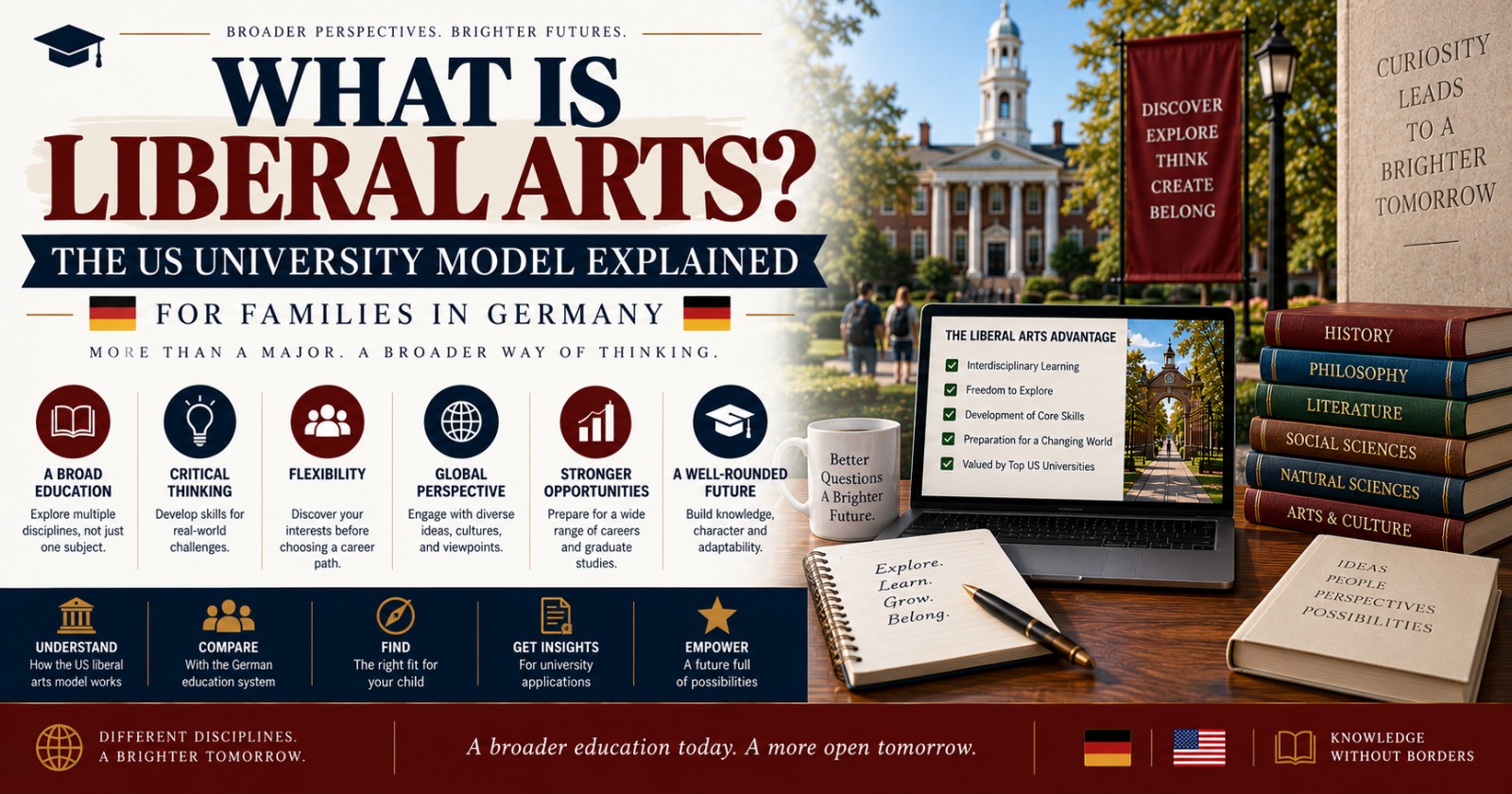
This article explains Liberal Arts from the ground up no academic jargon, no prior knowledge required. What it is, why it exists, how it differs from the German educational model, what you actually study, and why it matters for students in Germany who are considering a US university education.
What Liberal Arts Means — The Simplest Explanation
The term is misleading in translation. ‘Liberal’ here does not mean politically liberal. ‘Arts’ does not mean fine arts or art school. The phrase comes from Latin: Artes Liberales the arts of a free person, the education that makes a citizen capable of independent thought and civic participation.
In practice today, Liberal Arts means: at an American university, you do not study only one narrow subject from day one. In your first two years, you deliberately take courses across different disciplines natural sciences, humanities and social sciences, mathematics, arts before concentrating in a main subject (your Major or Concentration).
The goal is not to train a narrow subject specialist. The goal is to develop someone who can think across boundaries, communicate clearly, integrate multiple perspectives, and solve complex problems regardless of their field.
Why the German Educational Model Does Not Have This Concept
In Germany, a Bachelor’s degree works fundamentally differently. You apply for a specific degree programme Medicine, Law, Mechanical Engineering, Business, German Literature. You study that subject from day one, with a clearly defined curriculum. Humanities and sciences rarely overlap. You are a specialist from the start.
This is not better or worse it is a different educational ideal. The German model produces deep subject knowledge early. The American Liberal Arts model produces broad intellectual competence first, depth second.
For students in Germany considering a US university, understanding this difference is essential because it explains why you do not apply to Harvard ‘for Economics’ but rather apply to Harvard College, and then choose Economics as your Concentration (main subject) once you arrive.
How Liberal Arts Actually Works — Using Harvard as an Example
You apply to the university, not to a programme
At Harvard College, you apply as an ‘Undergraduate Student’ not as an Economics student or a Biology student. You are admitted to Harvard, not to a specific department. This gives you the first one to two years to explore different fields before choosing your Concentration.
For students in Germany who are beginning to understand how this application system works, ARC Consultancy’s complete guide to getting into Harvard from Germany provides a useful overview of the broader admissions process, including academics, extracurriculars, essays, testing and application strategy.
The Concentration: your main subject
At Harvard, the main subject is called a ‘Concentration’. Princeton and Yale call it a ‘Major’. The logic is similar everywhere: in your second or third year you formally declare your main subject. From then on you take advanced courses in that area. But you also continue taking courses outside your Concentration throughout your degree.
| Economics student at Harvard | Concentration: Economics — PLUS required courses in Mathematics, Writing, Sciences, Humanities |
|---|---|
| Computer Science student at Harvard | Concentration: CS PLUS Distribution Requirements outside Computer Science |
| History student at Harvard | Concentration: History PLUS required Quantitative Analysis, Science, Language courses |
General Education and Distribution Requirements
This is the structural core of the Liberal Arts system: every American university has requirements outside the main subject. At Harvard these are called ‘General Education’ (Gen Ed). You must take courses in specific categories for example in Science and Technology in Society, Aesthetics and Culture, Ethics and Civics, and Histories.
In practice: a Computer Science student is required to take a literature or philosophy course. A Biology student takes Statistics and a humanities course. An Economics student takes a required writing seminar. These are not optional enrichments they are mandatory components of every Harvard degree.
Why This System Exists — and What It Actually Produces
The Liberal Arts system has a philosophical core that dates to the 19th century and remains very much alive at American elite universities: a person who knows only one field is always a prisoner of that field. The truly important problems of the world climate change, AI ethics, global health, political polarisation have no solutions that come from a single discipline.
What Liberal Arts actually develops:
- Analytical thinking across disciplinary boundaries
- Written and verbal communication at a high level (writing is a central element of every Harvard degree)
- The ability to enter new fields quickly essential in a rapidly changing working world
- Cultural breadth and historical understanding
- Critical engagement with questions that have no single clear answer
What You Actually Study — Concrete Examples
A typical first year at Harvard
Imagine you are interested in Economics and want to go into consulting or finance. Your first year at Harvard might look like this:
| Fall Semester | Economics 10a (Intro Microeconomics), Expository Writing (required writing course), History of Science (Gen Ed requirement), Linear Algebra |
|---|---|
| Spring Semester | Economics 10b (Intro Macroeconomics), Gen Ed: Existential Questions (Philosophy/Ethics), Computer Science 50 (Introduction to Programming), Elective: German Literature |
By the end of your first year: you have studied Economics, Philosophy, History of Science, Programming and Writing. You can think and speak intelligently about more topics than almost any same-age Economics student in Germany and you have the breadth to notice whether you actually want to study Economics, or whether something you discovered in another course pulls you in a different direction.
Liberal Arts vs. Liberal Arts College — An Important Distinction
‘Liberal Arts’ as an educational philosophy (which Harvard, Yale, Princeton and MIT pursue) is not the same as a ‘Liberal Arts College’ (a small, standalone institution like Amherst, Williams or Pomona).
| Large Ivy League university (Harvard, Yale, Princeton) | Liberal Arts philosophy PLUS research university with PhD programmes, large departments, world-famous faculty, enormous resources |
|---|---|
| Liberal Arts College (Amherst, Williams, Pomona, Bowdoin) | Exclusively undergraduate focus, very small classes, intensive faculty-student relationships, no large research programmes, less well known in Germany |
For most students in Germany thinking about a US education, the Ivy League universities are the primary targets. All of them pursue a Liberal Arts educational philosophy within a larger research university context.
If you are comparing Ivy League universities more broadly, ARC Consultancy’s Ivy League admissions guide for students in Germany can help connect the Liberal Arts concept to the wider admissions process.
What Liberal Arts Means When You Apply as a Student in Germany
You do not need to declare a subject when you apply and this is an advantage
At most German universities, you need to know what you want to study before you apply. At Harvard, Yale and Princeton, you apply to the university not to a programme. You can be ‘undecided’. You do not need to know whether you want to study Economics or Physics or History. You need to know why you want to study at this particular university and what kind of thinker you are.
The application evaluates you as a whole person not as a subject candidate
Because Harvard is not admitting subject specialists but people for an educational experience, your entire profile is evaluated not only your performance in one subject. Grades, extracurricular activities, essays, recommendation letters, intellectual curiosity, character everything counts. This is ‘holistic admissions’, the opposite of the German Numerus Clausus.
This is also why understanding the complete US application process matters. ARC Consultancy’s University Admissions Consulting covers university selection, profile building, essays, recommendation letters and interview preparation for students applying to competitive universities in the USA and UK.
Your Abitur background actually fits the Liberal Arts idea well
The Abitur is in many ways good preparation for Liberal Arts you take Leistungskurse in different subjects, you write in German and in a foreign language, you have Mathematics AND Literature AND Biology. This broad Abitur profile is often more attractive to American admissions officers than the very early specialisation of British A-Level students who choose only three subjects at 16.
Frequently Asked Questions
Can you build a career with a Liberal Arts degree?
Yes and often more successfully than initially expected. Research from the Association of American Colleges and Universities consistently shows: employers prefer graduates who can think broadly, communicate clearly, and quickly enter new fields. These are exactly the skills Liberal Arts systematically develops. Harvard graduates work in consulting, investment banking, science, technology, politics, medicine, the arts across every sector. A Liberal Arts degree from a top university is not a limitation on a career. It is the foundation of a flexible, durable one.
What if I already know what I want to study?
Then Liberal Arts is still valuable or even especially valuable. You deepen your chosen main subject AND build a breadth that specialists without Liberal Arts education often lack. And many students who were certain they knew what they wanted to study change their Concentration after the first year because they discovered something in another course they did not know existed.
Is Liberal Arts available in Germany?
In very limited form a few universities (Hamburg, Freiburg, Giessen, KIT) have introduced Liberal Arts programmes in recent years. These are philosophically similar but not comparable in prestige or international recognition to Harvard or Yale. The European equivalent is more established in the Netherlands, where Liberal Arts and Sciences programmes have been running for decades.
How does the IB programme relate to Liberal Arts?
Very well, actually. The International Baccalaureate is one of the best preparations for a Liberal Arts education available to students in Germany. The IB’s mandatory breadth six subject groups including sciences, humanities, mathematics and language mirrors the intellectual philosophy behind Liberal Arts. IB students are often better prepared for the transition to a US Liberal Arts university than students from highly specialised national curricula.