There is a sentence I have never forgotten. I was sixteen, sitting in a counselling session, and I asked whether Harvard was realistic for me. The answer came without hesitation: ‘That is not for you. Focus on German universities.”
Seven months later, I was holding my Harvard College acceptance letter.
I do not share that to impress anyone. I share it because that moment is the reason ARC Consultancy exists and because I know that students in Germany are still receiving exactly the same wrong answer today.
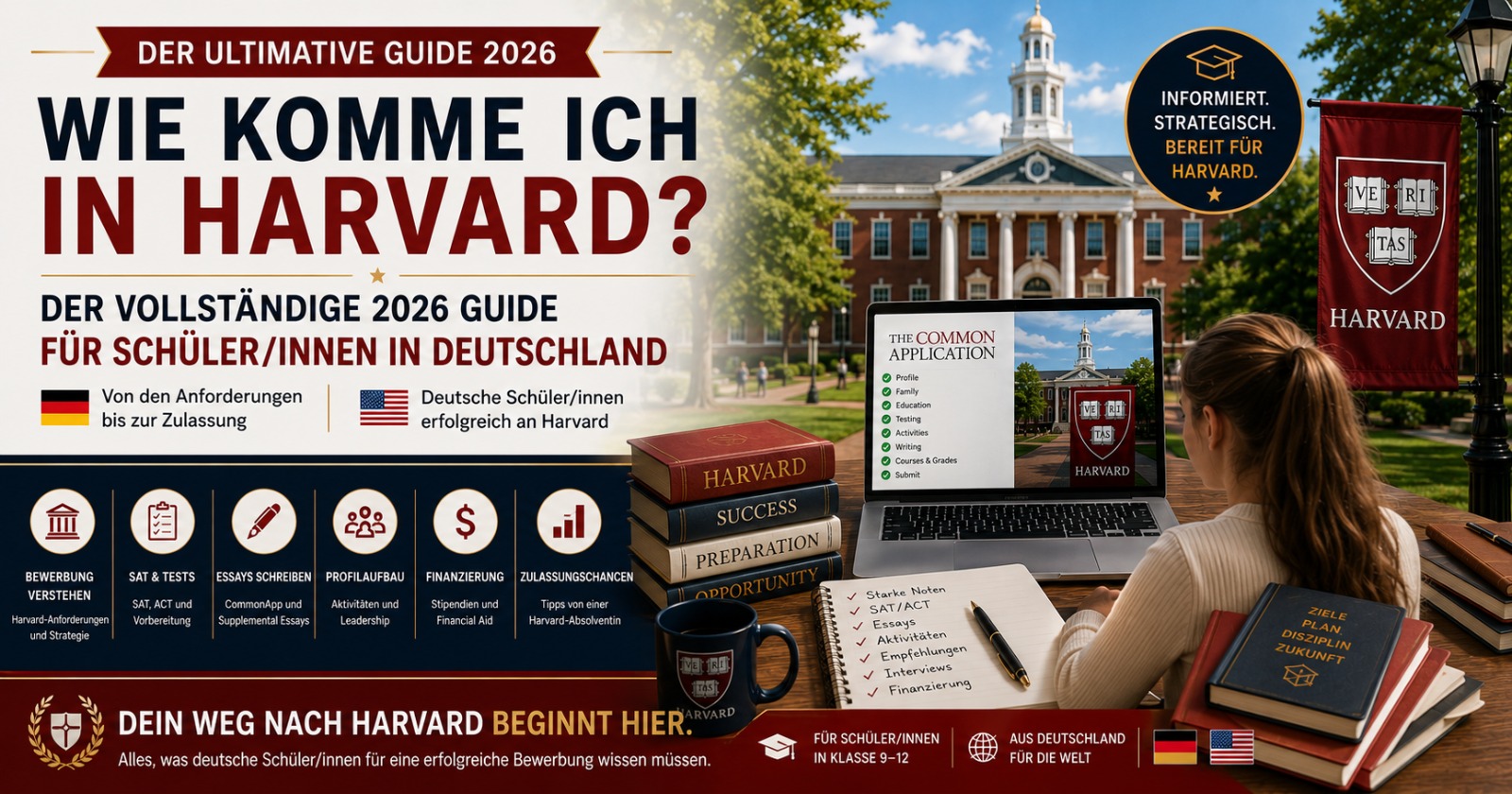
This guide gives you the real answer to the question I wasn’t given: what does it actually take to get into Harvard as a student studying in Germany?
💡 QUICK REFERENCE: Harvard Class 2029 — Acceptance rate 3.2% · Median SAT: 1580 · REA deadline: November 1 · RD deadline: January 1 · Need-blind for international students: YES (covers 100% of demonstrated need)
Can Students in Germany Actually Get Into Harvard?
Yes. And the answer is less complicated than most people assume. Harvard has no national quotas, no country restrictions and no disadvantage for international applicants. You are evaluated in the global pool on exactly the same basis as every other applicant.
What Harvard cares about is not where you are from. It is who you are, what you have achieved and what you will contribute. A student with a strong Abitur, a competitive SAT score, genuine extracurricular depth and a compelling essay competes on equal footing with a student from a top American prep school.
Harvard admits a small number of students from Germany every year. The question is: what did those students do differently?
Understanding Harvard’s 3.2% Acceptance Rate
| Total applications | Approx. 56,000 for the Class of 2029 |
| Admitted | Approx. 1,800 |
| Overall acceptance rate | 3.2% |
| REA acceptance rate | Approx. 7.4% — roughly twice the RD rate |
| Estimated unqualified applicants | 30-40% of total applications |
| Effective rate for qualified applicants | Significantly higher than 3.2% |
The 3.2% figure includes tens of thousands of applications from students who are not genuinely competitive who apply because Harvard is a dream, not because they have a realistic profile. If you are in the qualified pool strong academics, competitive test scores, real extracurricular depth you are competing in a smaller and better group than the headline number suggests.
What Harvard Really Looks For — The Five Dimensions
Dimension 1: Academic Excellence — The Foundation
Harvard expects the strongest academic record your school system makes possible. For students in Germany, that means:
| Abitur average | 1.0 to 1.3 is the target · 1.4-1.6 possible with exceptional strength elsewhere |
| Leistungskurse | Strong results in subjects relevant to your intended field of study |
| Grade trajectory | No declining grades across school years — consistency matters as much as peak performance |
| Format note | Harvard admissions officers understand the German grading system — no conversion required |
Dimension 2: Standardised Testing — SAT or ACT
Harvard requires the SAT or ACT. There are no exceptions for international applicants.
| Median SAT (Class 2029) | 1580 out of 1600 |
| Median ACT | 36 out of 36 |
| 25th percentile SAT | 1500 — lowest competitive benchmark |
| Practical minimum | SAT 1520 / ACT 34 for a genuinely competitive application |
💡 Pro tip for students in Germany: Take both the SAT and ACT as untimed practice tests before committing to intensive preparation. The analytical reasoning style of the German education system often translates well to the ACT format — many students score higher on it than expected.
Dimension 3: Extracurricular Profile — The Deciding Factor
This is the dimension where most students in Germany have the most room to grow — and the most potential. Harvard is not counting activities. Harvard is evaluating depth, leadership and genuine impact.
The distinction that changes everything: depth over breadth.
What Harvard looks for in extracurricular activities
- Sustained commitment — the same activity over multiple years, with growing responsibility
- Real impact — have you changed something? In your school, community or field?
- Leadership — not membership, but direction. Not participation, but initiative.
- Authentic passion — does the activity follow a genuine interest, or was it built for the application?
Strong extracurricular opportunities for students in Germany
- Olympiad competitions — Mathematics, Physics, Chemistry, Linguistics, Biology, at national or international level. These are well known and respected by Harvard admissions officers.
- Jugend forscht — Germany’s national student research competition. A very strong signal for STEM applicants.
- Deutsche Schülerakademie — highly selective, well regarded by US admissions committees.
- Model United Nations — particularly at university-level or international conferences.
- Self-created initiatives — tutoring programmes, NGOs, apps, community projects. Self-made opportunities consistently impress more than joining existing ones.
- Research assistantships at German universities — LMU, TU Munich and HU Berlin have programmes for school students.
- High-level music or athletic achievement — at national or international competition level.
Dimension 4: Essays — Your Voice, Your Story
The CommonApp Personal Statement is the only document in the entire application where Harvard stops reading your achievements and starts getting to know you as a person. It is the most important piece of writing you will produce for this application.
Harvard also requires five short-answer supplements of 150 words each. These are not optional they are mandatory for every Harvard applicant. They ask about intellectual interests, activities and other topics. Generic answers are immediately recognisable and quickly dismissed.
Full CommonApp Essay Guide: Commonapp Essay Guide
Dimension 5: Recommendation Letters
Harvard requires two teacher recommendations and a school counsellor report. For students in Germany, this is a practical challenge: German academic reference conventions differ significantly from what US admissions committees expect.
A German teacher reference tends to be formal and general. A strong US recommendation letter tells a specific story a moment when the student surprised their teacher, a question that changed the direction of a class, the precise quality that sets this particular student apart. Bridging that gap requires preparation and ARC regularly helps students guide their teachers through it.
The Harvard Application — Step by Step
Choosing your deadline: REA or Regular Decision?
Restrictive Early Action (REA): deadline November 1. Non-binding if admitted you are not obligated to attend. You may not apply early to other private universities simultaneously. Historical REA acceptance rates are roughly double the RD rate. If you are well prepared, apply for the REA.
Regular Decision (RD): deadline January 1. Decisions released late March (Ivy Day).
All application components
| CommonApp Essay | 650 words — Personal Statement |
| Harvard supplements | 5 short-answer questions, 150 words each |
| School counsellor report | From your Gymnasium counsellor |
| 2 teacher recommendations | From subject teachers — strategy matters |
| SAT or ACT scores | Submitted directly from College Board / ACT |
| School transcript | Abitur certificate or current grades |
| Alumni interview | Optional — where available in your region |
Realistic Timeline for Students in Germany
| Grades 9-10 | Build extracurricular activities · Begin SAT orientation · Discover intellectual interests |
| Grade 11 | Deepen activities and take on leadership · Sit SAT/ACT (spring) · Begin university list |
| Summer before Grade 12 | Essay brainstorming · Finalise list · Request recommendations (early summer) |
| September-October | Write and revise application · Submit test scores · Finalise Harvard supplements |
| November 1 | REA deadline — application submitted |
| Mid-December | REA decisions: Admitted / Deferred / Rejected |
| January 1 | RD deadline (if needed) |
| Late March | Ivy Day — final decisions released |
The Five Most Common Mistakes Students in Germany Make
Mistake 1: Starting too late
Harvard applications are the product of years of preparation, not months. The exceptional extracurricular profile that distinguishes admitted students is built in Grades 9 and 10 not assembled in a final year rush.
Mistake 2: Collecting activities instead of deepening them
Twelve activities with shallow involvement loses to four activities with genuine leadership and multi-year commitment. Harvard admissions officers have seen thousands of activity lists. They recognise the difference between authentic engagement and profile-filling immediately.
Mistake 3: Underestimating the essays
Strong CommonApp essays go through three to five substantial revision rounds. Students who begin brainstorming in September with a November deadline rarely produce their best work. Start in June or July of the summer before Grade 12.
Mistake 4: Generic Harvard supplements
Harvard’s short-answer questions require specific responses references to actual courses, research groups, communities. Vague enthusiasm for ‘Harvard’s excellent resources’ is immediately identified as generic and reads as low effort.
Mistake 5: Navigating the process without guidance
The nuances of the Harvard application — REA strategy, supplement framing, recommendation preparation, interview approach — are not taught at German Gymnasia. For students at international schools in Germany, the situation is slightly better but still far from comprehensive. Professional guidance makes a measurable difference.
Germany-Specific Considerations
Your Abitur in a Harvard application
Harvard admissions officers are familiar with the German Abitur and its 1-15 point grading scale. You do not need to convert your grades — submit them in their original German format. Harvard contextualises your performance within the German school system automatically.
Getting strong recommendation letters from German teachers
Ask your teachers early — ideally by June or July before your final year. And brief them on what makes a strong US recommendation letter different from a German academic reference: specific anecdotes, personal insights about your character, and qualities that appear nowhere else in your application. This briefing process is something ARC specifically supports students through.
The Harvard alumni interview in Germany
Harvard invites most applicants in regions with active alumni networks to an alumni interview — a 45-60 minute conversational meeting with a Harvard graduate. In Germany, these are typically available in Munich, Berlin, Hamburg, Frankfurt and Cologne. The interview is conversational, not a test. It focuses on who you are as a person, what you care about and how you think. If you receive an invitation — prepare, but don’t panic.
Frequently Asked Questions
What GPA do I need to get into Harvard from Germany?
Target an Abitur average of 1.0-1.3. Harvard does not publish minimum GPA requirements, but the median for the Class of 2029 was approximately a 4.0 US GPA equivalent. With an Abitur average weaker than 1.5, the application becomes very difficult without exceptional strength in other areas.
Can I get financial aid from Harvard as an international student?
Yes. Harvard is need-blind for international applicants and covers 100% of demonstrated financial need for every admitted student regardless of nationality. Families with household income below approximately $85,000 typically pay nothing at all. Applying for financial aid has no negative impact on your admissions decision.
Do I need to speak English as a first language?
No. Harvard does not require formal English proficiency exams (TOEFL/IELTS) for applicants who have had several years of English instruction. Your SAT scores and the quality of your application writing serve as evidence of your English proficiency.
How many students from Germany get into Harvard each year?
Harvard does not publish country-specific breakdown data for international students. Based on known cases and alumni networks, the number is small likely single to low double digits annually. That sounds discouraging. But it means the same thing it has always meant: it is possible, and it happens every year, to students who approached the process the right way.
2 responses