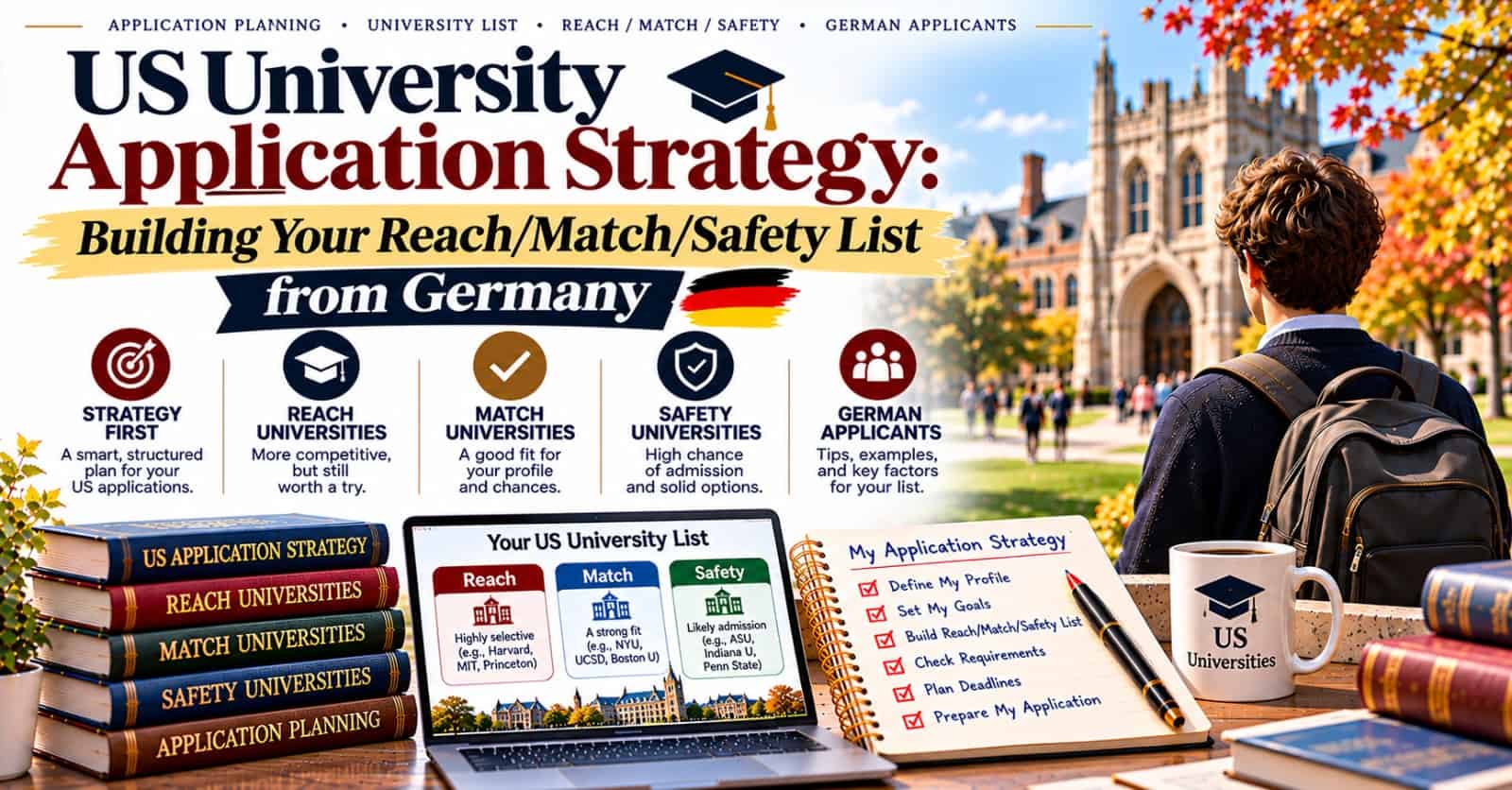
⚡ Direct Answer: A good application list covers 8-12 universities: 2-4 reaches (Ivy League, MIT, Stanford), 3-5 matches (selective, 15-30% acceptance rate), 2-3 safeties. Use Early Decision for a genuine first choice. It significantly increases chances. Most common mistake: too many reaches, no real safeties. Second most common: choosing safety universities you do not actually want to attend.
What Are Reach, Match and Safety?
Every university on your list belongs to one of three categories, and the right balance is critical.
Reach Universities
- Acceptance rates under 10-15%
- Your profile is at or above the typical admitted range, but competition is extraordinary.
- Typical reaches for strong German applicants: Harvard, Yale, Princeton, Columbia, MIT, Stanford, Dartmouth, Brown, Penn, Cornell (depending on profile)
- Rule of thumb: even the best profile has only a 10-30% chance at a true reach.
Match Universities
- Acceptance rates 15-35%
- Your grades, test scores and activities fall within the typical admitted range.
- Typical matches: Vanderbilt, Duke, Johns Hopkins, Georgetown, Rice, Emory, Tufts, Boston College, NYU, University of Michigan, UCLA, UC Berkeley.
- You have roughly a 30-55% admission chance at a good match.
Safety Universities
- Acceptance rates 40%+ for international applicants.
- Your profile is clearly above the average admitted student.
- IMPORTANT: A safety is only a safety if you would genuinely attend. A safety you hate is not a real option.
- Typical safeties: University of Rochester, Case Western Reserve, Tulane, Fordham, American University, University of Denver.
How Many Universities Should You Apply To?
- Fewer than 6: Risky. If all reaches reject, you have few options.
- 8-12: Optimal for most applicants. Enough diversity but still manageable.
- More than 14: Quality problem. Supplemental essays lose quality when written individually for 15 universities.
Recommended distribution for an Ivy League applicant from Germany:
- 2-3 Ivy/MIT-level reaches
- 1-2 Additional reaches (Stanford, Caltech, Duke, Georgetown, by profile)
- 3-4 matches (Vanderbilt, Emory, Tufts, Boston College, NYU, Michigan)
- 2 safeties (University of Rochester + Tulane, or Case Western)
For personalised guidance on building a balanced university list, explore ARC Consultancy’s University Admissions Consulting.
Early Decision Strategy
Early Decision is the most powerful strategic tool in the US application.
- Statistical advantage: Harvard ED 2024: ~14% acceptance rate vs. 3.9% RD. Yale ED: ~13% vs ~4%. A significant difference.
- Demonstration of Interest: ED signals that the university is your clear first choice. That counts.
- ED is binding: If admitted, you must attend and withdraw all other applications.
For more information, read our guide on Early Action vs. Early Decision for Students in Germany.
When ED Makes Sense and When It Does Not
- ED WORTHWHILE when: University is truly your clear first choice; profile matches well; financing is clarified or university is need-blind.
- ED NOT WORTHWHILE when: You want to compare multiple financial aid packages; you are still unsure which university truly fits; university is need-aware and you need full financing.
Sample Lists for Different Profiles
Profile A: STEM Top Applicant (IMO/IPhO, 1.0 Abitur, Jugend forscht)
- ED: MIT
- Reaches: Harvard, Princeton, Caltech, Stanford
- Matches: Carnegie Mellon, Duke, Johns Hopkins, Georgia Tech
- Safeties: University of Rochester, Case Western Reserve
Profile B: Well-Rounded Top Applicant (1.0-1.3, national competitions, leadership)
- ED: Yale or Columbia (by fit)
- Reaches: Harvard, Princeton, Dartmouth, Brown
- Matches: Vanderbilt, Georgetown, Tufts, Emory, Boston College
- Safeties: Fordham University, American University
Profile C: Strong Applicant with Niche Profile (1.3-1.7, clear interest, specific activities)
- ED: Brown (Open Curriculum) or Dartmouth
- Reaches: Columbia, Cornell, Penn
- Matches: NYU, Tulane, University of Michigan, Wesleyan
- Safeties: Skidmore, Dickinson, University of Denver
Common Mistakes in List Building
- Too many reaches, no safeties: “I am applying to 8 Ivy League universities and that is it.” That is not a plan, it is roulette.
- Choosing safety universities you do not want: a safety is only a real option if you would study there.
- Finalising list too early: the list should be finalised shortly before deadlines (October). Profile and preferences change.
- Not factoring in financing: if a safety is not financially realistic, it is not a real safety. Read our guide to Financing a US University in 2026: Financial Aid and Scholarships for more information.
Frequently Asked Questions
How many universities should you apply to?
Optimal: 8-12. Of these: 2-4 reaches, 3-5 matches, 2-3 safeties.
What is the difference between reach, match and safety?
Reach: rate under 15%, unpredictable. Match: 15-35%, realistic chances. Safety: 40%+, very likely and genuinely wanted.
When should you apply Early Decision?
When university is a clear first choice, profile fits, and financing is clarified. ED significantly increases chances (Harvard ED ~14% vs. RD ~3.9%).