Perhaps you are studying at a German university and realise it is not the right environment for your ambitions. Or you began at a US university that seemed right at the time and now see a clearer path toward somewhere more aligned with your goals. Or you took time after your Abitur and are now ready to pursue a top-tier degree programme.
In all of these situations, a transfer application may be the right path. Harvard, Yale, Columbia and other Ivy League universities admit a small but meaningful number of transfer students every year. This guide explains exactly how the process works from Germany.
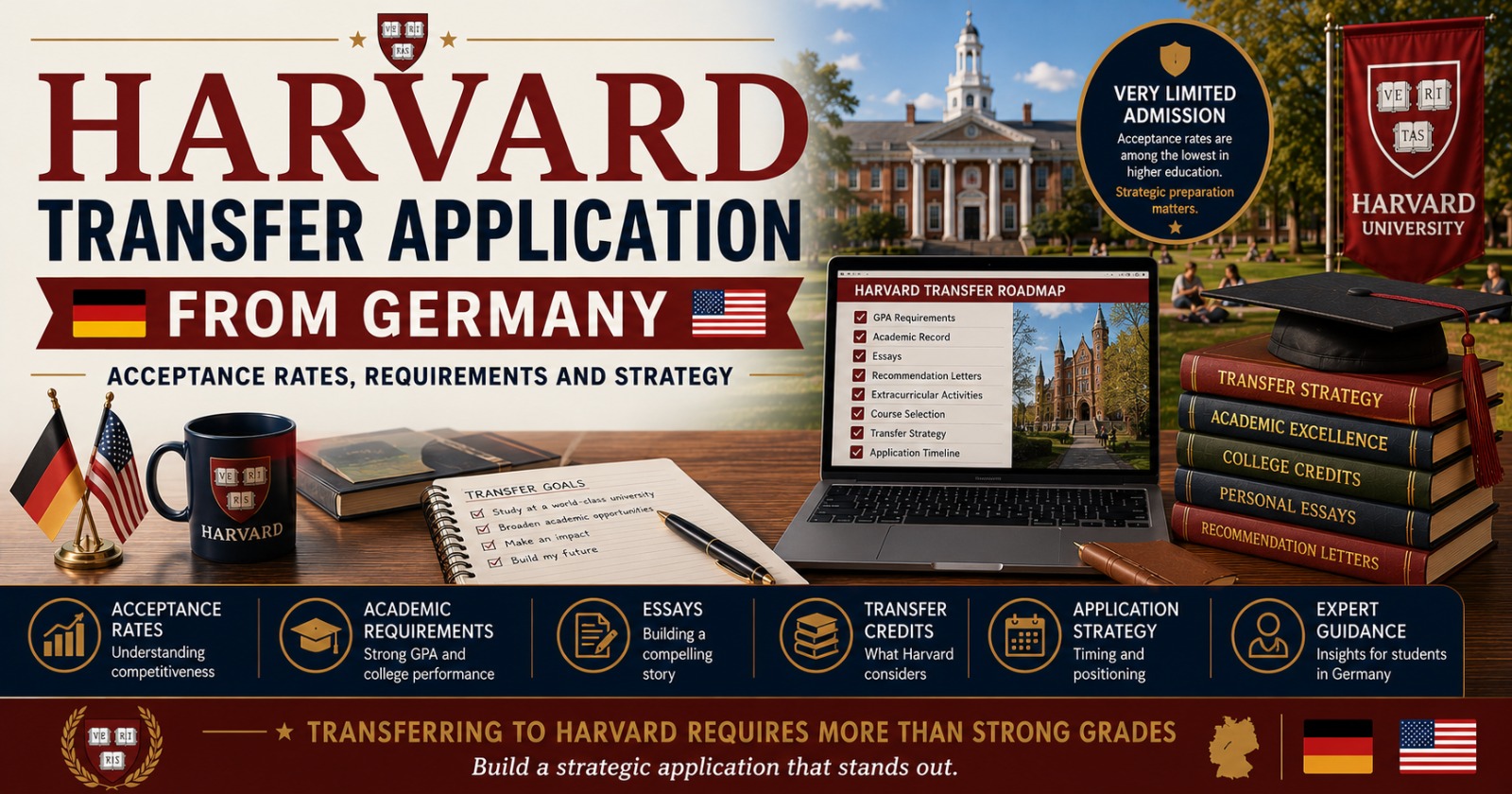
Hinweis: QUICK REFERENCE: Harvard transfer acceptance rate: approx. 0.8-1.5% — extremely selective. Cornell transfer: approx. 14% — significantly more accessible. Columbia transfer: approx. 6-8%. Most Ivy League transfer deadlines: March/April. Applications for second or third year entry.
Ivy League Transfer Acceptance Rates — Complete Data
| Harvard | Approx. 0.8-1.5% — admits approx. 12-15 transfer students per year from approx. 1,500 applications |
| Yale | Approx. 1-2% — similarly selective to Harvard |
| Princeton | Does NOT accept transfer students |
| Columbia | Approx. 6-8% — significantly higher than Harvard/Yale |
| Brown | Approx. 7-9% |
| Cornell | Approx. 14% — higher than Cornell’s own freshman acceptance rate |
| Dartmouth | Approx. 3-5% |
| Penn | Approx. 7-9% |
Hinweis: Harvard admits approximately 12-15 transfer students per year — an almost impossibly narrow target. However Cornell, Columbia and Brown have meaningfully higher transfer rates than their freshman rates. A strategic transfer list should be anchored by these more accessible options alongside Harvard and Yale as genuine reach applications.
What Makes Transfer Applications Different
A transfer application differs from a freshman application in several critical ways that applicants frequently underestimate:
- Your university academic record is now the primary academic indicator — more important than your Abitur or SAT
- Your university activities and achievements take priority over what you did in school
- Recommendation letters come from university professors, not from Gymnasium or school teachers
- The why-transfer essay is the centrepiece of the entire application — and must be answered specifically and compellingly
- You are applying to join a class mid-way through their degree — your fit with the specific year group and programme matters
What You Need to Be Competitive
| Academic performance at current university | Very strong transcript — GPA 3.8-4.0 at a selective institution |
| Courses completed | Sufficient coursework to demonstrate readiness — typically at least one full semester |
| University activities | Evidence of engagement at your current institution — research, clubs, leadership roles |
| Recommendation letters | From university professors — school teachers are no longer appropriate sources |
| Why-transfer essay | The most important document of the entire application |
| School records | Abitur/school transcript and test scores from high school are still required |
The Why-Transfer Essay — The Most Important Document
Every transfer application will ask: why are you leaving your current university? And why do you want to come here?
This is the most difficult essay in the entire transfer process — because it must do two things simultaneously. It must explain why you are leaving without disparaging your current institution. And it must deliver a convincingly forward-looking vision of what you intend to achieve at the target university.
- What does NOT work: ‘My current university is not good enough’ — sounds arrogant and unreflective
- What does NOT work: ‘I do not fit the culture at my current university’ — too vague, too personal
- What WORKS: Specific academic or career goals that cannot be achieved at your current institution
- What WORKS: Specific programmes, research groups or opportunities at the target university that directly address those goals
- What WORKS: A clear, honest and forward-looking narrative that demonstrates you know exactly why you belong there
Common Transfer Scenarios for Students From Germany
Scenario 1: From a German University to a US Top Institution
You began at LMU, TU Munich, HU Berlin or another German university and realise you want to pursue a top US institution. This is a legitimate and achievable goal, but requires strategic preparation: strong academic performance at your German university, meaningful research or project engagement, and a compelling why-transfer narrative. ARC regularly supports students at German universities through this process.
Scenario 2: From a US University to a More Selective US Institution
You are already studying in the US at a strong but less selective university and want to transfer to an Ivy League school. Here your university transcript is even more decisive — admissions committees want to see that you are performing exceptionally at your current institution, not just that you wish you were somewhere else.
Scenario 3: After a Gap Year or Study Break
You took one or two years after your Abitur and now want to begin at a top US university. In this case you may be applying as a freshman or as a transfer student depending on the university’s specific requirements and how you have spent that time. ARC can help you determine which route makes more sense for your specific situation.
Strategic Priorities for Transfer Applicants From Germany
- Priority 1: Exceptional grades at your current university — this is the single most important factor
- Priority 2: Build research assistantship or other meaningful university-level activities before applying
- Priority 3: Invest in your recommendation relationships with university professors from the start of your current degree
- Priority 4: Build a realistic list — Cornell, Columbia and Brown are more accessible transfer targets than Harvard and Yale
- Priority 5: Start early — most Ivy League transfer deadlines are in March, so preparation should begin in November or December of the preceding year
Frequently Asked Questions
What is the Harvard transfer acceptance rate?
Harvard admits approximately 12-15 transfer students per year from approximately 1,500 applications — an acceptance rate of approximately 0.8-1.5%. It is among the most selective transfer processes in the world. Cornell, with a transfer acceptance rate of approximately 14%, is significantly more accessible and is often the most realistic Ivy League transfer target for students from Germany.
Can I transfer from a German university to Harvard?
Yes — but the probability is very low. What matters most is your academic performance at the German university (strong grades in rigorous courses), what you have contributed at the German university outside of class, and a very compelling why-transfer essay that demonstrates genuine alignment between your goals and Harvard’s specific offerings. ARC has supported students at German universities through this process and can advise on what a competitive application looks like.
Will my credits from a German university transfer to a US university?
That depends on the specific university and programme. Many US universities accept credits from German institutions, but transferability is evaluated individually. In some cases you may need to repeat certain foundation courses. The credit evaluation typically occurs after admission, not before. ARC can help you understand what to expect based on your specific situation and target institutions.
When should I start preparing my transfer application?
If your target transfer deadlines are in March, begin serious preparation in November or December — at least four months before the deadline. The why-transfer essay takes multiple revision rounds to get right. Professor recommendation letters need time to develop and request appropriately. Starting in February for a March deadline is not sufficient time to produce a strong application.