
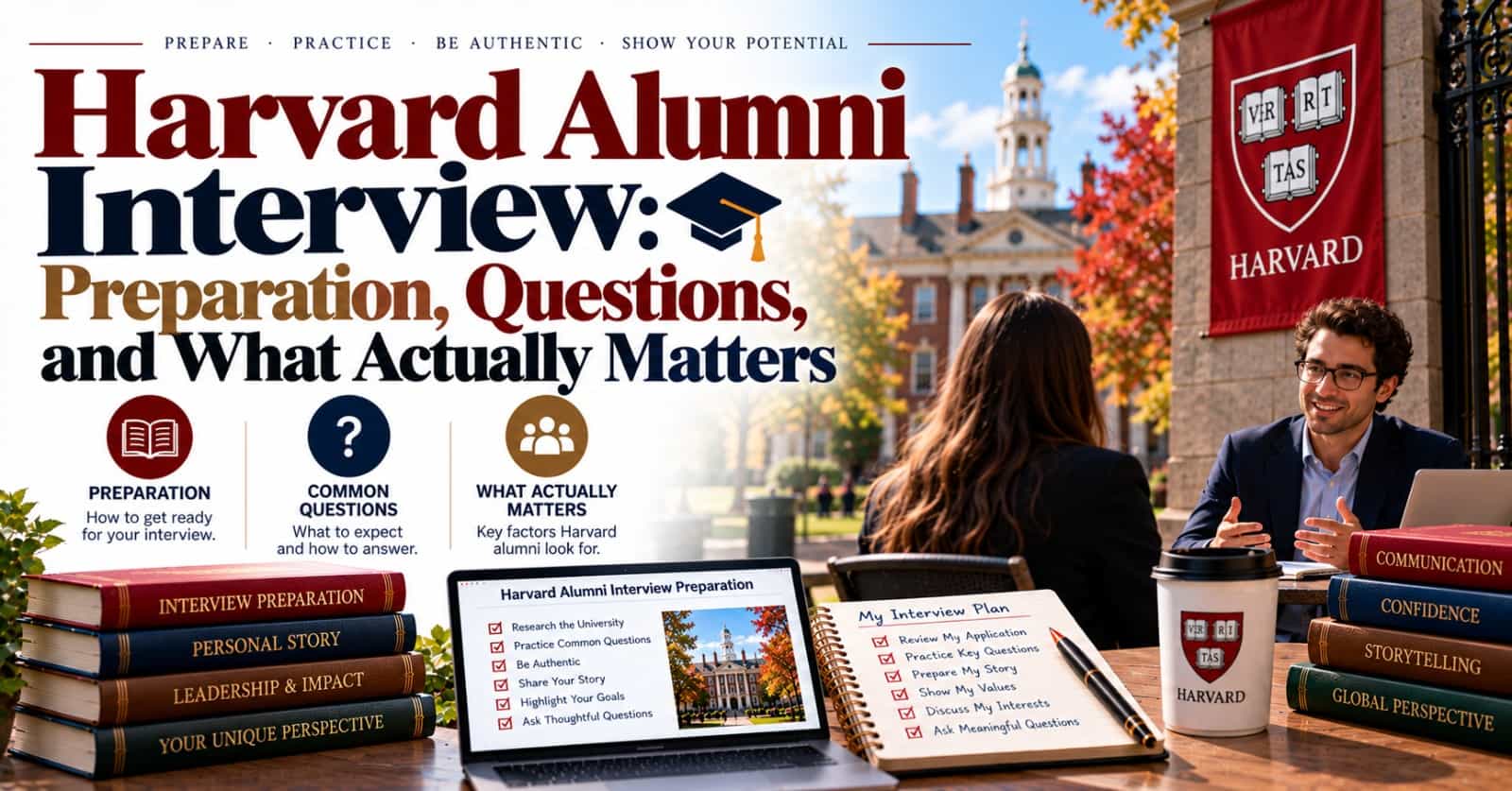
The Harvard Alumni Interview is for many applicants from Germany one of the most anxiety-inducing moments in the entire application process. In reality, it is one of the most open and least formal elements of the Harvard application. This guide explains how it actually works, what to expect, and how to prepare effectively.
What Is the Harvard Alumni Interview?
The Harvard Alumni Interview is a 30-60 minute conversation with a Harvard graduate from your region, volunteering for the Harvard Admissions Committee.
Harvard does not conduct a formal interview in the academic sense. There is no examination, no test questions, no right or wrong answer. The interviewer does not read your file in full and does not know your grades in detail, they receive only your name and basic information.
The conversation is designed to build a picture of you as a person, capturing what grades and essays cannot. How do you communicate? How do you think? Are you curious, engaged, reflective?
How and when you receive an invitation
- Invitations are sent after submission of your REA or RD application, often October-December (REA) or January-February (RD)
- A Harvard alumnus from your region contacts you by email
- If you do not receive an invitation: no mark against you, it depends on alumni availability in your region
- In Germany, alumni interviewers are present in most major cities; smaller towns or rural areas may receive virtual interviews
Format: In-person or virtual
- Common: café, library, interviewer’s office
- Virtual option: Zoom or similar, widely used since 2020
- Duration: 30-60 minutes, typically approximately 45 minutes
- Dress: Smart casual, no suit required, but not a t-shirt either
Typical Harvard Interview Questions
The Harvard Alumni Interview follows no rigid script, but there are core questions that appear in almost every interview.
The 10 most common Harvard interview questions
Tell me about yourself.
The most important opening question. Not your CV in chronological order. Choose 2-3 things that genuinely define you and deliver them with energy and specificity. Approximately 2-3 minutes.
Why Harvard?
Concrete, not generic. Not “because of the world-class education.” Instead: specific programmes, professors, clubs, courses that only Harvard has and that connect directly to your interests.
What is your most meaningful extracurricular activity?
Explain not just WHAT, but WHY it matters to you. What did you learn? How did it change you?
What are you reading right now? What have you read recently?
Harvard interviewers love this question. Prepare a genuine, specific answer, not a canonical “required reading” book. Show curiosity and self-directed learning.
What would you change about your school or community?
Shows critical thinking and leadership potential. Not a complaint, a thoughtful solution.
What do you want to study and why?
Show intellectual curiosity and depth, not just “because I’m good at maths.” What genuinely interests you about this field?
Describe a challenge you have overcome.
Concrete, personal, honest. Not always the biggest achievement, sometimes a small, real story shows more character than a polished trophy.
What would your friends say about you?
Self-awareness. Show that you know yourself, with humour and honesty.
Is there anything you wish you could tell the Harvard Admissions Committee?
Your opportunity to say something important that does not come through in your file. Prepare something, but only if it is genuinely relevant.
Do you have questions for me?
Always prepare these. Weak question: “What is the weather like in Cambridge?” Strong question: “What surprised you most when you arrived at Harvard?” or “What would you do differently in your studies?”
How Much Does the Harvard Interview Actually Count?
Harvard describes the interview as “supplemental information”, a contributing factor in holistic review, not a decisive one.
The reality from the admissions context: most interviews are neutral to slightly positive. No interview alone will tip a decision with a rating of “absolutely exceptional.” But a genuinely poor interview, where the applicant appears disinterested, unprepared, or socially awkward, can negatively influence a borderline application.
In short: an interview cannot get you in, but it can keep you out. Preparation is therefore worth the effort.
How to Prepare for the Harvard Interview
The best interview preparation is not memorising answers, it is thinking carefully through your own story.
Step 1: Know your own story
Re-read your CommonApp application. What are the 3-5 most important things about you? What makes you who you are? Which activities and experiences have genuinely shaped you?
Step 2: Prepare Harvard-specific answers
“Why Harvard?” must be concrete. Research: which professors, programmes, courses exist only at Harvard? Which clubs or institutions match your interests?
Step 3: Practise, but do not memorise
Run a practice interview with someone who will give honest feedback. ARC Consultancy offers structured interview coaching sessions with genuine practice interviews and detailed feedback.
Step 4: Think in English, do not translate
The interview is in English. Respond in English, do not compose in German and translate. Speak clearly and directly; perfect grammar matters less than clarity and authenticity.
Step 5: Prepare questions for the interviewer
Prepare 3-4 genuine questions to ask the interviewer. They should demonstrate that you have thought about Harvard and have genuine interest in the conversation.
Yale, Princeton, and Other Ivy League Interviews: What Is Different?
Yale, Princeton, Columbia, and other Ivy League universities have similar alumni interview structures, but with important differences.
- Yale: Alumni interview similar to Harvard; also optional, no guarantee of interview
- Princeton: Princeton interviews are considered slightly more formal; interviewer reports carry similar weight
- Columbia: No alumni interview programme of the same scale
- Penn: Alumni interviews are offered; also optional
- Cornell: No interviews (except for specific programmes such as Architecture)
ARC Consultancy prepares applicants from Germany for interviews at all Ivy League universities. Explore university admissions consulting for guidance on university selection, application strategy, and interview preparation.
Frequently Asked Questions
Is the Harvard interview required?
Optional, Harvard cannot guarantee an interview for every applicant. Not receiving an invitation carries no negative weight.
What questions are asked in the Harvard interview?
Tell me about yourself. Why Harvard? What are you reading? What would you change about your school? What do you want to study? What would your friends say? Do you have questions for me?
How much does the Harvard interview matter?
Supplemental factor, not decisive. A poor interview can hurt; a strong one confirms your application.
How long does the Harvard Alumni Interview last?
30-60 minutes, typically approximately 45 minutes. Café, library, or virtual.
Is the Harvard interview conducted in English?
Yes, always in English. Thorough preparation in English is particularly important for applicants from Germany.