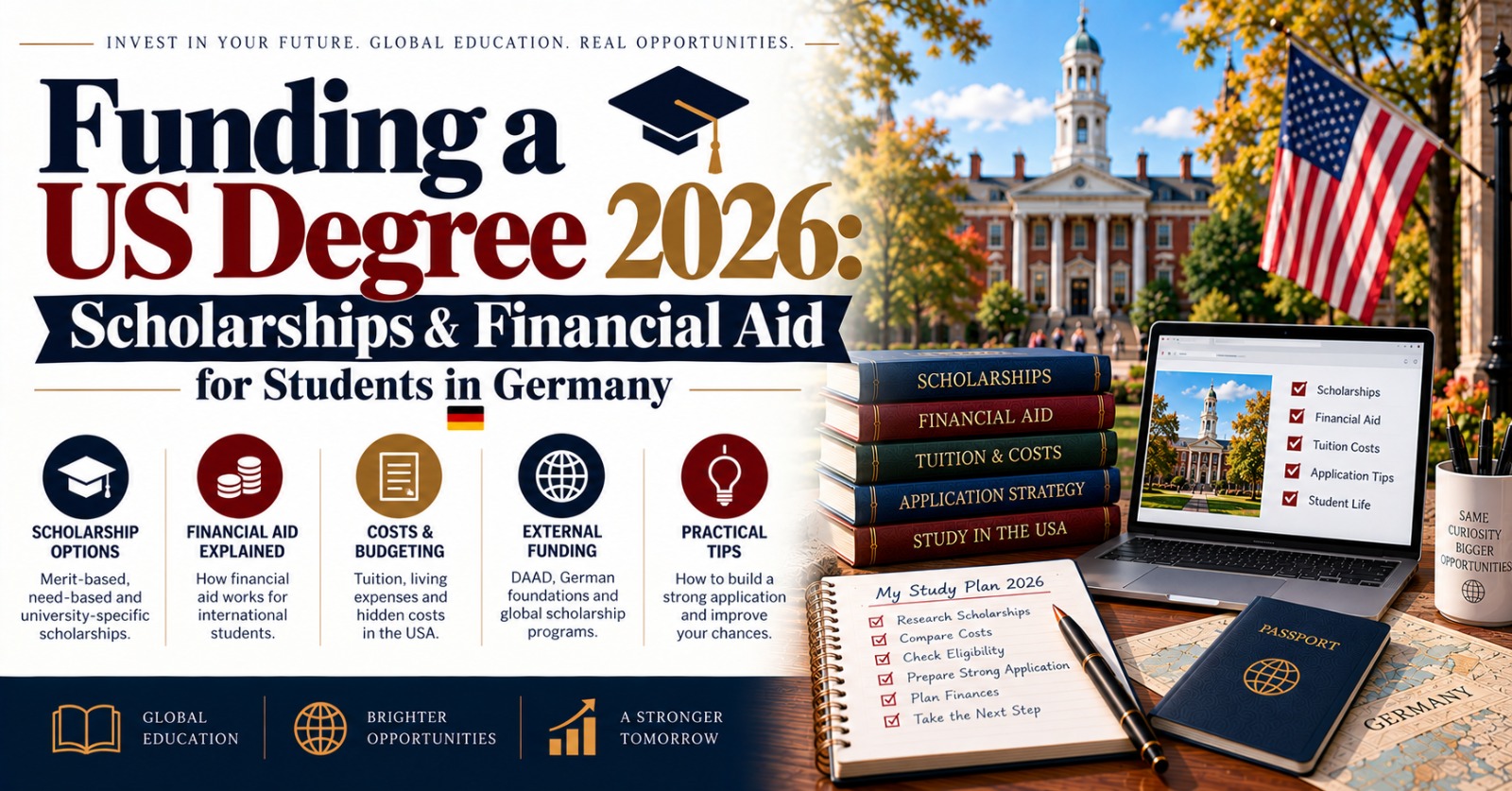
The single biggest misconception that keeps qualified students in Germany from applying to top US universities is the assumption that $90,000 per year is the price they will pay. It is not. Harvard, Yale, Princeton, and other leading US institutions have financial aid programmes that make attendance genuinely affordable for families across almost every income level, including international students.
This guide explains how financial aid at US universities works, what distinguishes need based aid from merit scholarships, what German funding sources exist, and what you need to do to apply for support.
What a US Top University Degree Actually Costs
The Sticker Price and Why It Misleads
The published “Cost of Attendance” figures for the 2026 to 2027 academic year at most Ivy League universities fall between $85,000 and $95,000 annually. This encompasses tuition, room, board, books and materials, and personal expenses.
This figure is the starting point, not what most students pay. The actual price for families with demonstrated financial need can be significantly lower, and at the most financially generous institutions, it can approach zero for lower income families.
What Families Actually Pay: Harvard as a Benchmark
Harvard’s financial aid model provides a useful example of how institutional support can reduce the actual cost of attendance.
- Family income below approximately $85,000 per year: Often $0 contribution through full funding with Harvard grants
- Family income from $85,000 to $150,000 per year: Contribution typically 0% to 10% of annual income
- Family income from $150,000 to $200,000 per year: Contribution approximately 10% of income
- Family income above $200,000 per year: Higher contribution, but still substantially subsidised
These are reference figures from Harvard’s published financial aid data. Yale, Princeton, MIT, Dartmouth, and other need blind institutions have comparable programme structures.
Need Blind vs. Need Aware: What It Means for You
What Does Need Blind Mean for International Applicants?
Need blind means the university makes its admissions decision without considering the applicant’s financial situation. Whether your family earns $50,000 or $500,000 annually has no bearing on whether you are admitted. The admissions committee reads your file without knowing your financial profile.
Universities that are need blind for international applicants as of 2026 include Harvard, Yale, Princeton, MIT, and Dartmouth. These institutions also commit to meeting the full demonstrated financial need of every admitted student.
What Does Need Aware Mean for International Applicants?
Most other US universities are need aware for international applicants, meaning financial circumstances can factor into the admissions decision.
Need aware does not automatically mean international applicants with financial need have no chance. It means institutional budget constraints play a role. At need aware schools, applicants with high demonstrated need face a modest additional challenge.
Need Based Financial Aid: How the Process Works
Understanding the CSS Profile
Financial aid at US universities is not automatic. You must apply for it separately through the CSS Profile, or College Scholarship Service Profile, a document filed through the College Board.
The CSS Profile asks detailed questions about your entire family’s financial circumstances, including parental income, assets, debts, siblings in education, property, and more.
For international applicants, there are specific adaptations for non US financial systems. The form accommodates the fact that your family’s finances will not follow a US tax structure.
CSS Profile Timing and Deadlines
Financial aid deadlines can vary between universities, so students should always verify the exact dates for each institution.
Typical deadlines include:
- REA or ED applicants applying around November 1, 2026: CSS Profile deadline is typically the same day or shortly after
- RD applicants applying around January 1, 2027: CSS Profile deadline usually falls in December 2026 or January 2027
- Individual institutions may have different CSS Profile deadlines, so check each university’s financial aid website carefully
What Happens After You Submit the CSS Profile?
The university calculates your Expected Family Contribution, or EFC, from your CSS Profile. This represents the amount the university assesses that your family can contribute.
The gap between the Cost of Attendance and the assessed family contribution represents your demonstrated financial need.
Need blind institutions commit to covering this gap in full through grants, which do not require repayment, work study opportunities involving campus employment, and sometimes modest loan components.
Merit Scholarships at the Ivy League: An Important Clarification
Do Ivy League Universities Offer Merit Scholarships?
A critical clarification is that most Ivy League universities, including Harvard, Yale, Princeton, Columbia, Penn, Brown, Dartmouth, and Cornell, do not award merit scholarships in the conventional sense.
There are no institutional grants awarded solely on the basis of academic achievement independently of family income.
The institutional scholarship programme at these universities is primarily need based. This means that if your family has no demonstrated financial need, you will generally receive no institutional financial support regardless of how exceptional your academic credentials are.
Universities Outside the Ivy League With Merit Scholarships
Several highly selective universities outside the Ivy League, including Vanderbilt, Rice, and Duke, do award merit scholarships to international applicants.
If merit aid is relevant to your situation, including these universities in your application list is worth considering.
German Funding Sources for US Study
DAAD: German Academic Exchange Service
The DAAD is Germany’s largest academic exchange organisation and offers various programmes for study abroad.
Undergraduate specific programmes for US study are more limited than at the postgraduate level. The DAAD focuses more strongly on graduate and research stays.
Students should check the current DAAD programme offerings to identify opportunities relevant to their academic level and intended study programme.
Fulbright Programme
The Fulbright Programme is a bilateral US German exchange programme.
It primarily targets graduates and doctoral candidates, but opportunities for undergraduate study stays also exist.
In Germany, the programme is administered by the German American Fulbright Commission.
German Political Foundations
Several German foundations provide scholarship opportunities for students pursuing higher education in Germany and abroad.
Konrad Adenauer Stiftung
The Konrad Adenauer Stiftung is affiliated with the CDU and provides scholarships for undergraduate and graduate study, including international study opportunities.
Friedrich Ebert Stiftung
The Friedrich Ebert Stiftung is affiliated with the SPD. Its programmes have a strong emphasis on social justice, civic engagement, and academic achievement.
Heinrich Böll Stiftung
The Heinrich Böll Stiftung is associated with the German Greens and focuses on areas such as environmental issues, democracy, and gender equality.
Hanns Seidel Stiftung and Rosa Luxemburg Stiftung
The Hanns Seidel Stiftung, associated with the CSU, and the Rosa Luxemburg Stiftung, associated with Die Linke, provide additional scholarship opportunities.
All of these foundations offer scholarship programmes that can include international study. Eligibility typically requires strong academic performance, civic engagement, and some degree of alignment with the foundation’s values.
Application processes are separate from university applications and have their own deadlines.
Studienstiftung des deutschen Volkes
The Studienstiftung des deutschen Volkes is Germany’s most prestigious merit based scholarship organisation.
It supports undergraduate and graduate study both in Germany and internationally, including study in the United States.
One particularly relevant feature is that the Studienstiftung explicitly supports study abroad. Recipients planning to attend a US university may receive German scholarship support alongside institutional financial aid.
Entry generally requires school nomination or an initiative application based on academic and personal profile.
Additional German and International Funding Sources
Students should also explore other scholarship organisations and funding programmes.
Potential sources include:
- Hertie Foundation, with a focus on Europe, governance, and leadership
- Carl Zeiss Stiftung, particularly for STEM students with connections to Baden Württemberg and Thuringia
- Rotary International Youth Exchange programmes
- University specific international scholarships offered directly by US universities
Many US universities maintain separate scholarship funds for international students. These opportunities can often be identified through the university’s financial aid office.
Strategic Considerations for Funding Your US Degree
Need Blind vs. Need Aware Should Influence Your Application List
If your family has genuine demonstrated financial need, prioritise need blind institutions such as Harvard, Yale, Princeton, MIT, and Dartmouth in your application strategy.
At these schools, your financial situation is not considered as a disadvantage during admission, and the institution commits to covering your full demonstrated financial need if you are admitted.
However, admission to these universities remains extremely competitive. Financial aid availability should therefore be considered alongside academic fit, programme strength, admission strategy, and your overall application profile.
Compare Financial Aid Packages Carefully
If you receive offers from multiple universities, those offers may contain very different financial aid packages.
Pay particular attention to:
- Grants, which generally do not require repayment
- Work study, which involves campus employment
- Loans, which must be repaid
The total package value matters, but its composition matters as well. A package heavily weighted toward loans may be less favourable than a package primarily consisting of grants.
Synchronise Your CSS Profile With Application Deadlines
One of the most common financial aid mistakes is submitting the CSS Profile after the relevant deadline.
Late submission can reduce or eliminate your eligibility for certain financial aid allocations.
Submit the CSS Profile at the same time as your university application, or earlier when permitted.
Missing the financial aid deadline can mean giving up support for which you might otherwise have qualified.
Build a Funding Strategy Before Applying
Funding should not be treated as an afterthought. Before submitting applications, create a realistic financial plan that includes:
- University based financial aid
- German scholarship opportunities
- External scholarships
- Family contribution
- Potential work study
- Travel and relocation expenses
- Health insurance and personal expenses
- Emergency financial reserves
This approach helps you understand the actual affordability of each university rather than focusing only on the published Cost of Attendance.
Students who need additional guidance can also explore admissions counselling and funding strategy to better understand application planning, university selection, and financial considerations when applying to US universities.
Admissions Counselling and Further Reading
For personalised support with US university applications and funding strategy:
Admissions counselling and funding strategy
Further Reading
- Ivy League Acceptance Rates 2026: What the Numbers Really Mean
- Early Action vs Early Decision: Strategy Guide
- CommonApp Personal Statement 2026 to 2027: Complete Guide
Frequently Asked Questions
Can German Students Receive Financial Aid at US Universities?
Yes. Harvard, Yale, Princeton, MIT, and Dartmouth are need blind for international applicants and cover the full demonstrated financial need of admitted students.
What Does an Ivy League Degree Actually Cost?
The listed Cost of Attendance is approximately $85,000 to $95,000 per year. With financial aid, families may pay significantly less depending on their financial circumstances.
At Harvard, families below approximately $85,000 per year may pay nothing under the university’s financial aid model.
What Is the Difference Between Need Based Aid and Merit Scholarships?
Need based aid is determined according to family financial circumstances. Merit scholarships are awarded based on achievement independently of financial need.
Ivy League institutions generally provide need based institutional aid rather than traditional merit scholarships.
What German Scholarships Exist for US Study?
Potential funding sources include DAAD, Fulbright, Studienstiftung des deutschen Volkes, Konrad Adenauer Stiftung, Friedrich Ebert Stiftung, Heinrich Böll Stiftung, Hanns Seidel Stiftung, Rosa Luxemburg Stiftung, and other scholarship organisations.
Do I Need to Apply for Financial Aid Separately?
Yes. International students generally need to complete the CSS Profile separately from their CommonApp application when applying to universities that use the CSS Profile for institutional financial aid.
The financial aid deadline typically aligns closely with the university’s application timeline, but deadlines vary by institution. Always check the individual university’s requirements and deadline.