
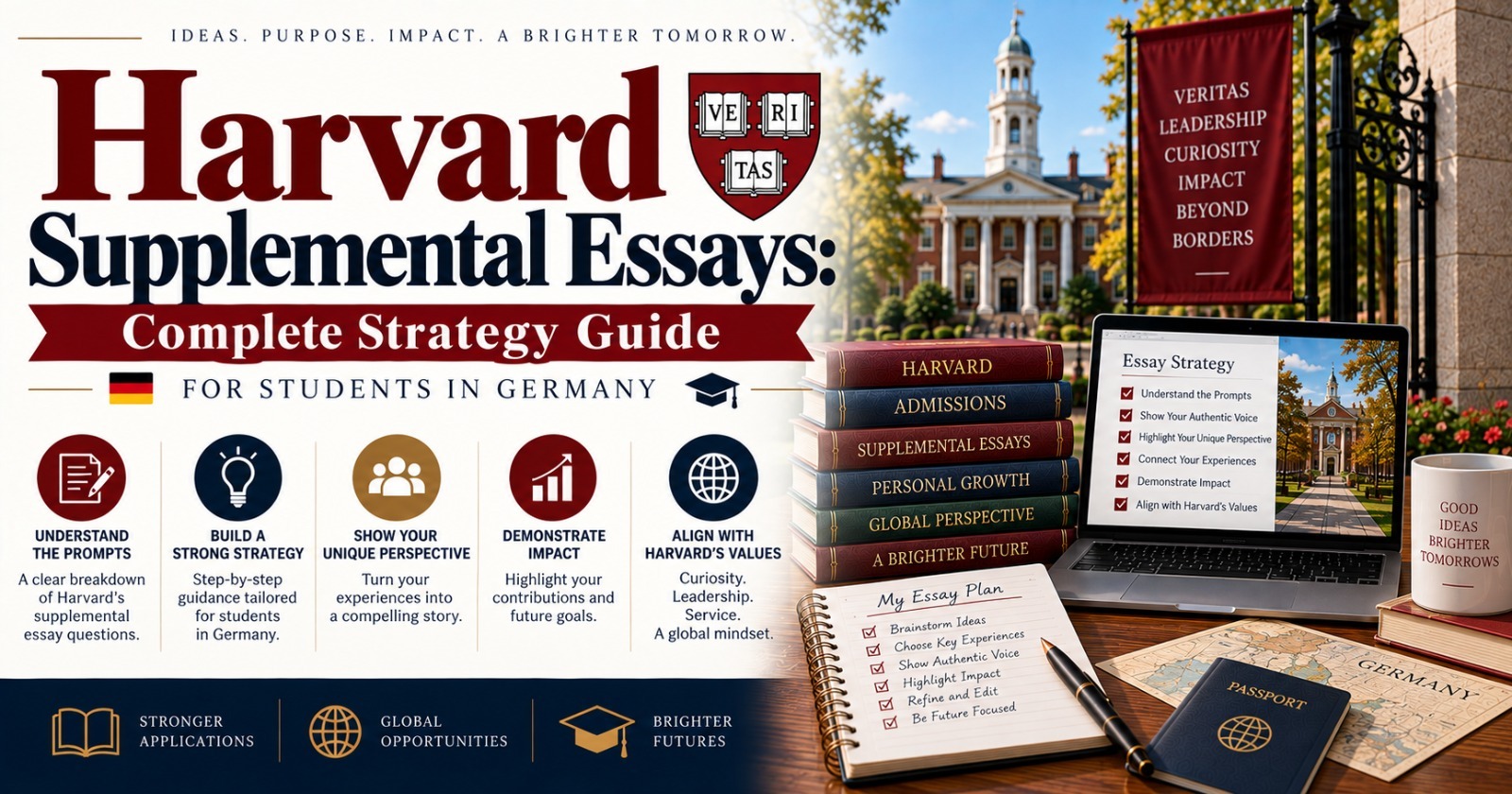
November 1, 2026 is 33 days away. If you are applying to Harvard Restrictive Early Action, you already know that the five supplemental essays sit at the centre of your application, not on the periphery. No other highly selective university uses essays constructed quite like these: short, purposeful, and designed to reveal exactly who you are when stripped of the word count buffer a 650 word personal statement affords.
This guide walks through all five prompts in full, what Harvard is actually asking, why each prompt exists, what strong responses look like, and what students applying from Germany specifically should understand about how these essays land with admissions readers.
This article is part of ARC Consultancy’s Harvard Cluster. If you haven’t yet read our full guide on structuring a Harvard application from Germany, we recommend starting there: How to Get Into Harvard: Complete Guide for Students in Germany.
What Are the Harvard Supplemental Essays for 2026–27?
Harvard requires five short essays as part of the Common Application, supplemental to the personal statement (650 words). Each supplemental essay has a hard cap of 150 words. The prompts for 2026–27 are unchanged from the previous cycle.
These essays are not peripheral. For Harvard admissions officers reading files where test scores, GPAs, and extracurricular profiles all skew exceptional, the supplementals are often the primary instrument of differentiation. In a class of approximately 2,000 students selected from over 56,000 applications, an overall acceptance rate of around 3.5%, the distinction between an accepted and a waitlisted student often comes down to these five brief responses.
The Five Prompts
Prompt 1: Contribution & Diversity
“Harvard has long recognized the importance of enrolling a student body with a diversity of perspectives and experiences. How will the life experiences that shaped who you are today enable you to contribute to Harvard?”
Prompt 2: Disagreement
“Describe a time when you strongly disagreed with someone about an idea or issue. How did you communicate or engage with this person? What did you learn from this experience?”
Prompt 3: Extracurricular / Experience
“Briefly describe any of your extracurricular activities, employment experience, travel, or family responsibilities that have shaped who you are.”
Prompt 4: Future
“How do you hope to use your Harvard education in the future?”
Prompt 5: Roommate
“Top 3 things your roommates might like to know about you.”
Prompt 1: Contribution & Diversity: What Harvard Is Actually Asking
This is the most strategically significant of the five prompts, and the most commonly misunderstood. The wording is deceptively open, but the question is precise: Harvard is not asking what makes you special. Harvard is asking how your life experiences will enable you to contribute to Harvard.
That distinction matters enormously. Many applicants write essays about themselves, their challenges, their achievements, their identity. That is not wrong. But it is incomplete. Harvard is asking you to face outward, toward the institution and community, not inward toward self description.
What Strong Responses Do
- Anchor on one specific experience or perspective, not an identity category
- Show how that experience shaped your thinking, not just your biography
- Connect that thinking to a concrete contribution at Harvard, and name specific programmes, spaces, or conversations
- Sound like a person, not a college essay
The Perspective Advantage for Students in Germany
Students applying from Germany carry a genuine asset that admissions officers at Harvard value: a perspective formed outside the American educational and cultural experience. Growing up in Germany means navigating a different relationship between education and society, encountering debates that rarely surface in American classrooms, and possessing a vantage point on transatlantic and European questions that is genuinely underrepresented in Harvard’s student body.
The risk, however, is writing an essay that uses this identity as a label rather than a lens. “I am German and will bring a European perspective” is not a contribution. It is a category. “Growing up debating the tensions between collective solidarity and individual freedom in the context of Germany’s post war social contract gave me a framework for engaging with political philosophy that I want to test in Harvard’s Justice seminar” is a contribution.
Structure for 150 Words
- Sentences 1 and 2: Drop immediately into a specific experience or moment. Avoid an abstract opening.
- Sentences 3 to 5: Explain what that experience revealed about your thinking or perspective.
- Sentences 6 to 8: Show how that perspective translates into a concrete contribution at Harvard. Be specific about courses, communities, or conversations.
- Final sentence: End with a closing image or statement that stays with the reader.
Prompt 2: Disagreement: The Essay That Reveals Intellectual Character
The Disagreement essay is the most misread of the five. A large proportion of applicants write essays about conflicts where they were right and the other person was wrong. That approach misses the point of the prompt entirely.
Harvard is not asking whether you were correct. Harvard is asking how you engage with disagreement, how you hold your ground while remaining genuinely open, how you communicate with someone whose view differs from yours, and what you learn from that encounter. The content of the disagreement is secondary. The quality of your engagement is primary.
What This Essay Actually Evaluates
- Intellectual maturity: Can you take a contrary position seriously?
- Communication under pressure: How do you speak with someone you disagree with?
- Capacity for learning: Did you come out of the conversation with something new, even if your position held?
- Respect: Do you treat the other person as a genuine intellectual equal?
The Strongest Disagreement Essays Share These Features
They choose a substantive disagreement, over something that matters: a scientific question, an ethical dilemma, a political judgment, or an artistic interpretation. The weakest essays choose conflicts that feel either too trivial, such as a grade dispute with a teacher, or artificially constructed for the essay.
The strongest essays do not end with a victory narrative. “I realised my original position had a blind spot I had not previously seen” is more compelling than “and in the end, I was right.” Harvard is building a community of people who can think together, not debate winners.
Germany Specific Context
German academic culture prizes structured, evidence based argumentation and a certain directness in intellectual exchange. Those are genuine strengths to draw on in this essay.
A disagreement navigated with rigour, fairness, and a willingness to acknowledge complexity reads very differently from an emotional confrontation narrative. If you have experienced substantive intellectual disagreements, in a Model United Nations context, in a seminar, in a political internship, or in your family around a dinner table about history, those are worth exploring here.
Prompt 3: Extracurricular: Not a List, a Story
This prompt seems redundant: you have already filled ten activity entries in the Common Application. Why write about activities again?
The reason is the word limit: each Common App activity entry gives you 150 characters. This essay gives you 150 words. That is not more space for a list. It is space for a story. The essay asks how an activity, experience, or responsibility shaped you, not what you did, but who you became through doing it.
If you are still developing your extracurricular profile, ARC Consultancy’s guide to extracurricular activities for Ivy League applications from Germany provides additional context on depth, leadership, initiative, and impact.
What to Choose
- Ideally, something that does not appear elsewhere in your application, or that appears without adequate explanation
- Or the one activity that is your deepest “spike”, where you can show the most depth and authenticity
- Employment or family responsibility counts fully and can be deeply compelling
- For students from Germany, exchange programmes, European political engagement, international academic competitions, and cross cultural experiences can provide meaningful material
The Strategic Last Sentence
Many applicants write descriptive essays and stop there. An effective closing sentence can show, implicitly, how this experience prepared you for Harvard.
Avoid a declarative “and that is why I want to attend Harvard.” Instead, consider something more natural: a statement about how this experience shaped the kind of thinker, collaborator, or community member you are now.
Prompt 4: Future: The Most Underestimated Essay
“How do you hope to use your Harvard education in the future?” This prompt appears simple. It is not. It is the essay where a common critical error occurs: applicants write about what they want to become rather than why a Harvard education is the right path toward that.
What Harvard Is Actually Asking
Harvard is not simply asking about your career ambitions. The prompt gives you an opportunity to explain the relationship between what a Harvard education specifically offers and where you are trying to go, and, implicitly, why Harvard is relevant to that path.
Strong responses demonstrate genuine knowledge of what Harvard provides: the flexibility of its General Education requirements, the resources of specific research centres, the opportunity for interdisciplinary study across the Faculty of Arts and Sciences, and access to faculty whose work intersects with your interests.
Vague statements such as “a world class education” or “incredible opportunities” demonstrate little engagement with Harvard as an institution.
For Students in Germany: The Transatlantic Angle
If your goals connect to global policy, transatlantic relations, European governance, international research, or comparative law, these are areas where Harvard’s specific resources can be relevant and where a perspective formed in Germany can add authentic depth.
The Weatherhead Center for International Affairs, the Center for European Studies, the Harvard Kennedy School’s global programmes, or the opportunity to build a career that bridges European and American institutional frameworks are examples of concrete connections worth researching.
A word of caution: sound open, not scripted. “I will become X researcher” can be less revealing than “I hope Harvard’s integration of A and B will help me contribute to X.” Your future does not need to be completely determined. It needs to be thoughtfully considered.
Prompt 5: Roommate: The Essay Most Applicants Approach Wrong
“Top 3 things your roommates might like to know about you.” This prompt carries a strong temptation: it reads as casual and personal, and many applicants try to smuggle their serious qualities in through a light hearted register. The result can sound strained.
What This Essay Is For
The Roommate essay gives you an opportunity to show your genuine personality, not the strategically constructed applicant, but the person who will show up in September to live with strangers.
Harvard wants to know: What are you like as a fellow human being? What do you do when no one is watching? What surprises people about you?
The strongest responses are honest and specific. “I love coffee” is generic. “I make espresso at 6:30 every morning, and I always make enough for two if you want to talk before the rest of the day starts” shows personality.
Specific habits, quirks, loyalties, and enthusiasms are what make this response memorable.
Strategic Balance: Authenticity vs. Application Strategy
- Show aspects of your personality that appear nowhere else in your application
- Humour is welcome and can be effective if it sounds natural rather than performed
- At least one of your three things should reflect a real passion or strength, not only a quirk
- For students from Germany, cultural particulars, specific traditions, language habits, routines, or unexpected enthusiasms can provide distinctive details
Five Common Mistakes in Harvard Supplemental Essays
1. Writing Academically Instead of Personally
Harvard essays should sound like you speaking honestly, not like an academic paper or a formal letter.
German educational culture can produce writers who are excellent at structured argument and less accustomed to personal, direct expression. The supplementals reward the latter. Write in the first person, use specific details, and prioritise clarity and authenticity over excessive formality.
For additional guidance on developing a compelling application essay, see ARC Consultancy’s CommonApp Essay Topics and Examples guide, which focuses on specificity, voice, depth, honesty, and relevance.
2. Summarising Instead of Showing
With only 150 words, every sentence must carry specific weight.
“I am a curious person who loves learning” tells an admissions officer very little. “I spent two weeks building a regression model to test a claim in an economics paper I found unconvincing” provides an actual glimpse into how you think and act.
The instinct to summarise should therefore be actively resisted.
3. Writing the Essays as Five Separate, Disconnected Pieces
Admissions officers read your five essays together, as a set. They are looking for a coherent picture of a person, not five unrelated snapshots.
Before finalising your essays, read them in sequence. Do they collectively tell a story? Are there contradictions? Is there a throughline, a set of values, interests, or qualities, that emerges across all five?
4. Underestimating the International Perspective
Applicants from Germany may underestimate the value of bringing a non American perspective into a diverse university environment.
A student who has developed their views through a different educational, cultural, or social context can contribute a distinct perspective to classroom discussions. But this advantage must be demonstrated through specific experiences and insights rather than simply claimed.
5. Waiting Too Long
November 1 is the REA deadline. For students in Germany, this can mean navigating the October 15 UCAS deadline simultaneously if they are also applying to Oxford or Cambridge.
The supplemental essays should ideally be substantially complete before the final week of October, leaving enough time for proofreading and a full application review.
Timeline for Students Applying from Germany: REA November 1, 2026
September 29: Brainstorm
Brainstorm all five prompts without worrying about perfect wording. Give yourself approximately 20 minutes per prompt and focus on experiences, moments, ideas, and details.
October 6: Complete First Drafts
Have first drafts of all five essays completed. At this stage, prioritise substance over perfection.
October 13: Revision
Complete a focused revision pass. Look for specificity, authentic voice, unnecessary repetition, and generic statements.
October 20: External Feedback
Get feedback from someone who understands US admissions and can evaluate the essays without rewriting them in their own voice.
October 27: Final Revision
Complete your final revisions and proofreading.
October 28 to 31: Full Application Review
Review your entire Common Application. Confirm that your counsellor and recommenders are on track and verify all application details before submitting.
Note for students managing UCAS simultaneously: The October 15 UCAS deadline falls two weeks before Harvard REA. If you are applying to Oxford or Cambridge alongside Harvard REA, your UCAS personal statement, references, and university choices must be complete before you can fully focus on the Harvard supplementals. Build your timeline accordingly. For students managing both applications simultaneously, working with a counsellor who understands both systems can help with planning and feedback.
How ARC Consultancy Supports Harvard Applicants
ARC Consultancy’s university admissions consulting supports students through university selection, profile building, CommonApp and supplemental essay development, recommendation strategy, interview preparation, and essay feedback.
For students who have already written their essays, ARC also provides detailed essay feedback focused on clarity, structure, narrative, and impact. The service is designed around feedback and mentoring rather than writing essays on behalf of students.
ARC Consultancy’s essay feedback service works with students who have already written their essays and are seeking rigorous, informed feedback from the perspective of US admissions.
The service focuses on more than grammar. The feedback process examines authentic voice, clear perspective, genuine reflection, specificity, and the qualities that distinguish a memorable application from a competent one.
Further Reading from the Harvard Cluster
- How to Get Into Harvard: Complete Guide for Students in Germany
- Harvard Financial Aid: What Students in Germany Need to Know
- Harvard Interview Preparation: What Is Actually Asked
- Best Extracurricular Activities for Ivy League Applications from Germany
- What GPA Do You Need to Get Into Harvard from Germany?
ARC’s current site also positions recommendation-letter guidance as part of its US and UK application support, including guidance specifically for teachers in Germany.
Frequently Asked Questions
How Many Supplemental Essays Does Harvard Require for 2026–27?
Harvard requires five short supplemental essays for 2026–27, each capped at 150 words. The prompts are unchanged from the previous application cycle.
What Is the Harvard REA Deadline for 2026?
The Harvard Restrictive Early Action (REA) deadline is November 1, 2026 at 11:59 PM Eastern Time, equivalent to November 2, 2026 at 05:59 AM Central European Time (CET).
Can I Apply to German Universities While Applying Harvard REA?
Yes. Harvard REA is non binding and permits simultaneous applications to German universities and other non US institutions. REA restrictions do, however, affect applications to certain US Early Decision programmes, so applicants should review Harvard’s current application rules before submitting applications elsewhere.
Which Harvard Supplemental Essay Matters Most?
Rather than treating one supplemental as inherently more important, applicants should approach all five as parts of the same application narrative. Each prompt provides a different opportunity to show experiences, perspectives, intellectual engagement, goals, or personality.
Should I Use AI to Write My Harvard Supplemental Essays?
Applicants should follow Harvard’s current application instructions regarding AI and essay assistance.
Regardless of the specific tools permitted, the content submitted should accurately represent the applicant’s own experiences, ideas, voice, and writing. Using AI to fabricate experiences or produce an essay that does not represent the applicant can undermine the purpose of the supplemental essays: allowing admissions readers to understand the individual behind the application.