
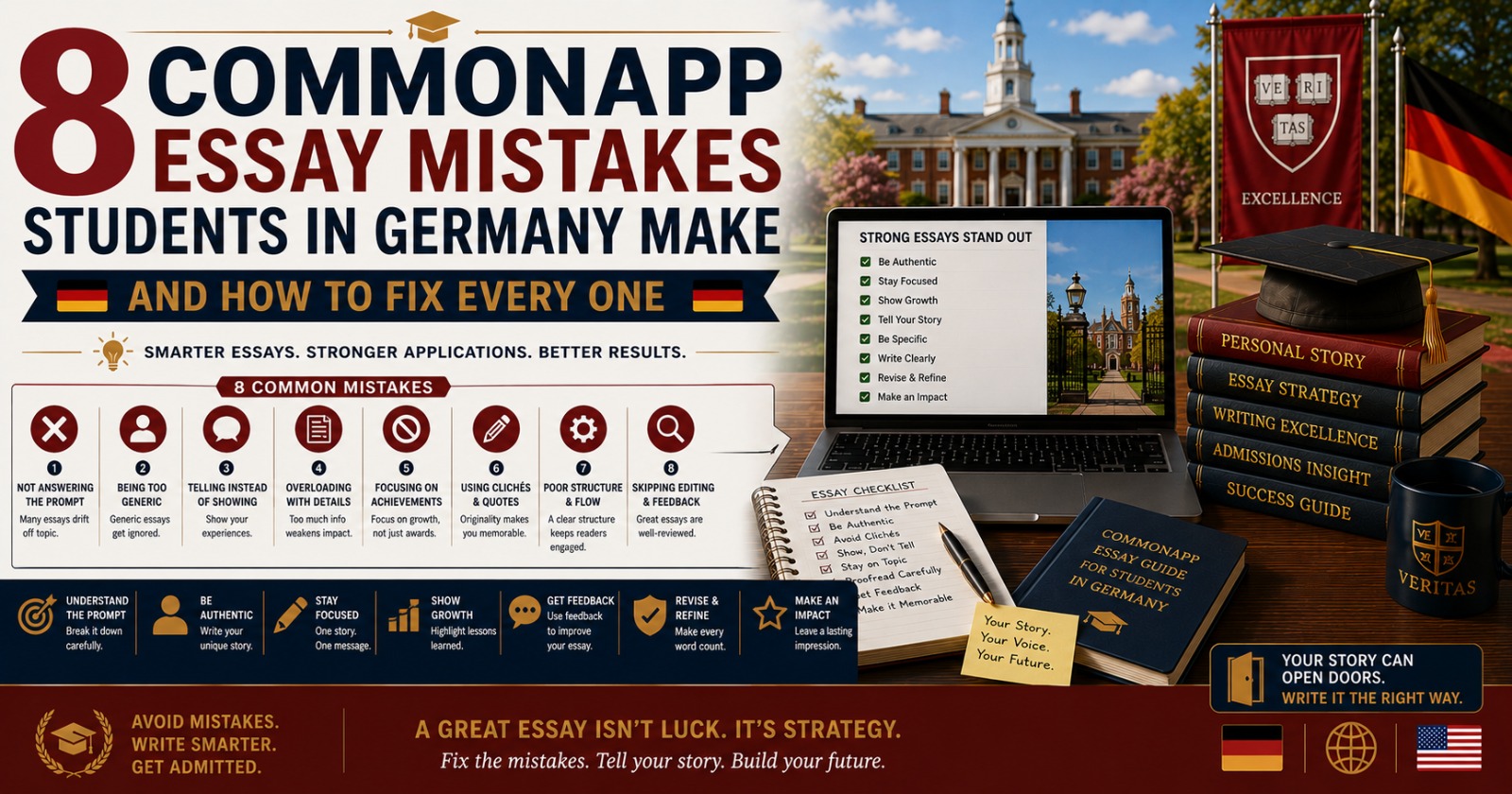
A good CommonApp essay is not created in the first draft. It is created through revision through recognising and removing mistakes that weaken the essay. After working with many applicants and hundreds of essay drafts, eight mistakes appear repeatedly.
The good news: all eight are recognisable. All are avoidable. And all have clear alternatives.
Mistake 1: Writing a Resume in Prose
What this looks like
‘Since Grade 9 I have been an active member of the school orchestra. In Grade 10 I took over leadership of the first violin section. In Grade 11 we won third place at the Bundeswettbewerb…’ That is not a story. That is an activity list with verbs. Admissions officers already see this information in your activity list. The personal statement exists to show something that is not there.
What works instead
Instead of describing playing violin: describe the moment in rehearsal when you understood that dissonance resolution is not error correction but breath. That is a story. That shows how you think.
Mistake 2: Starting with a Generic Observation or Definition
How this mistake appears
‘The world is a complex place.’ ‘In life we encounter many challenges.’ ‘Since I was a child I have always known I wanted to do something meaningful.’ These openings read like unfinished first sentences because they are.
What works instead
Begin with a concrete image, a specific scene, an unexpected sentence. ‘The cadaver of the fruit fly under the microscope looks like a shattered galaxy.’ That is an opening. The reader wants to know what comes next.
Mistake 3: Too Much Explaining, Not Enough Showing
The symptom
Essays with too many sentences like: ‘This experience taught me that perseverance matters.’ ‘Through this project I learned teamwork.’ ‘I realised that diversity is an asset.’ These are conclusions without content lessons without the story that proves them.
The rule
Show first. Explain after and then only briefly. The essay should allow the reader to understand for themselves why you are the way you are. Not: you tell them.
Mistake 4: The Topic Is Too Large for 650 Words
What this means
‘How the climate crisis changed my thinking’ is not an essay topic. It is a book topic. ‘The moment in physics class when I understood that one additional degree Celsius in the atmosphere represents a physical decision, not an abstraction’ that is an essay topic.
The smaller and more specific the topic, the more depth the essay can reach. A large topic in 650 words stays inevitably shallow. A small topic in 650 words can go deep.
Mistake 5: Too Many People in the Essay
The pattern
Essays that begin ‘My grandmother taught me…’ and then increasingly tell more about the grandmother than about the applicant. Or essays with so many family members, friends and teachers mentioned that the applicant themselves becomes a supporting character.
The rule of thumb
Every other person in the essay should play a role that says something about YOU not about themselves. If after reading your essay someone else in it seems more impressive than you: cut them.
Mistake 6: Building the Essay Like a German Eroerrterung
Why this is a specific issue for students in Germany and in IB
The German Abitur and the IB programme both train a particular mode of analytical writing: thesis, argument, counterargument, synthesis, conclusion. This structure is excellent for analytical texts but damaging for the CommonApp essay. A personal statement built like an academic essay reads as distant, formal and impersonal.
What works instead
The CommonApp essay works narratively it shows rather than proves, it tells rather than argues. The structure is closer to a well-written personal essay in a literary magazine than to an academic analysis. This is not an inferior form of writing it is a different form. Students who can move between both styles have a genuine advantage.
Mistake 7: The Essay Sounds Like Every Other Essay
The symptom of the generic essay
If you read your essay and think: ‘This could have come from almost any applicant’ that is a problem. An essay about ‘my commitment to my school community’ sounds like thousands of others. An essay about the specific moment you understood why school transparency means more to you than fairness sounds like no one else’s.
The test
Remove your name from the essay. Could this essay have come from someone else? If yes: the essay is not finished yet.
Mistake 8: AI-Generated or AI-Polished Text
Why this is especially relevant in 2026
The temptation is understandable: ChatGPT, Claude or Gemini can produce in seconds an essay that is grammatically correct and thematically coherent. The problem is not the grammar. The problem is that AI-generated essays are identifiable through their characteristic sentence constructions, their predictable metaphors and their uniform rhythm.
More significantly: admissions officers at Harvard, Yale and Princeton read these essays alongside essays written by real people with real voices. The contrast is immediately visible.
What is permitted
Brainstorming conversations with AI: permitted. Grammar checking: permitted. Sorting ideas: permitted. Writing or fundamentally rewriting the actual text: not permitted. And not in the academic interest of the applicant regardless.
Frequently Asked Questions
Are there topics I should absolutely avoid?
No absolute prohibitions but certain topics are so common that only extraordinary execution makes them stand out: sports comeback essays, mission trip essays, death of a loved one essays, generic study abroad growth essays. If you choose one of these topics, your specific execution must be truly exceptional.
How long should the revision process take?
Plan at least 4-6 weeks for the entire essay process from the first brainstorming session to the final version. Last-minute essays written in one night typically look like last-minute essays.
Is it a mistake to write about something from Germany specifically?
Absolutely not it is often a strength. But only if you show the specific impact of that experience on how you think, rather than just describing the German context as though it is inherently interesting. The context becomes interesting through what you make of it.