
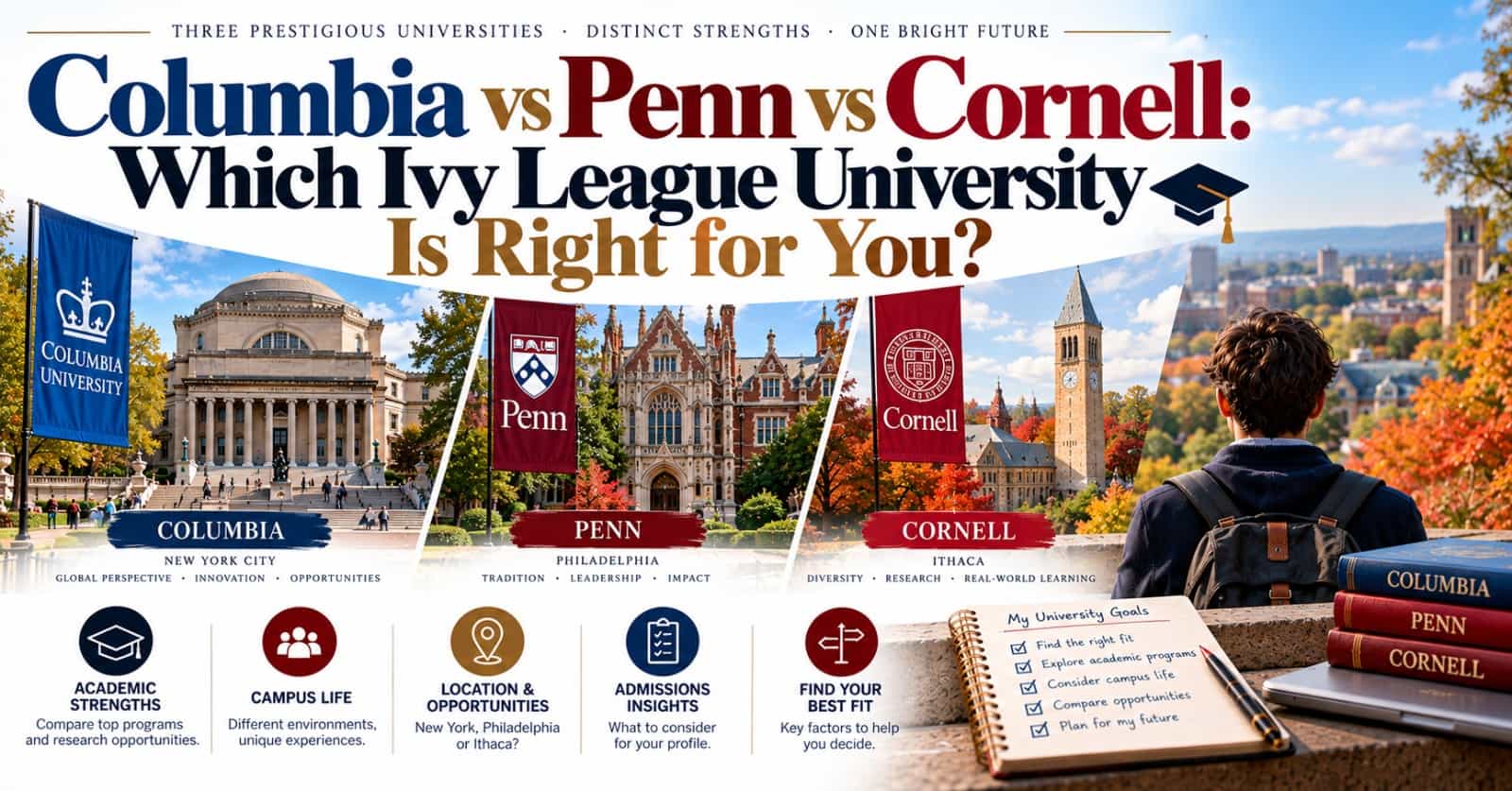
Harvard, Yale, and Princeton are the most recognisable Ivy League names for most students in Germany. But Columbia, Penn, and Cornell are no less demanding, no less prestigious, and for many applicant profiles, actually the better fit.
This comparison goes deeper than acceptance rates. It explains what genuinely distinguishes these three universities and gives you a clear basis for your decision.
At a Glance: Columbia, Penn, and Cornell Side by Side
The three universities differ most fundamentally in location, campus character, and core academic programme, not merely in acceptance rates.
Columbia University
- Location: Morningside Heights, Manhattan, New York City
- Acceptance rate 2026: ~3.9% (approximately 60,000 applications)
- Defining feature: Core Curriculum, two-year mandatory humanities programme
- Strengths: Liberal Arts, Journalism (Columbia Journalism School), Law, Medicine, International Relations, Film
- Undergraduate college: Columbia College or School of Engineering and Applied Science (SEAS)
- Housing: Mandatory first year in residence
- City life: Maximum urban experience, NYC as campus extension
University of Pennsylvania (Penn)
- Location: Philadelphia, Pennsylvania (University City neighbourhood)
- Acceptance rate 2026: ~5.9% (approximately 50,000 applications)
- Defining feature: Wharton School, the world’s leading undergraduate business school
- Strengths: Business/Finance (Wharton), Nursing, Engineering (SEAS), Liberal Arts (College), Design (Weitzman)
- 4 undergraduate schools with dual-degree possibilities
- City life: Philadelphia, major city with strong college culture, more affordable than NYC
Cornell University
- Location: Ithaca, New York (Finger Lakes region)
- Acceptance rate 2026: ~7.4% (approximately 67,000 applications)
- Defining feature: Largest Ivy with the broadest course selection, including engineering, architecture, agriculture
- Strengths: Engineering (#7 in US), Hotel Administration (globally pre-eminent), Architecture, Computer Science, Veterinary Medicine
- 7 separate undergraduate colleges with direct-admission to each
- City life: Small university town Ithaca, campus life dominant, natural surroundings, gorges
The Columbia Core Curriculum: Asset or Burden?
The Columbia Core Curriculum is a two-year mandatory humanities programme that all Columbia College students must complete, regardless of major.
The Core comprises: Literature Humanities (Lit Hum, reading the canon from Homer to Virginia Woolf), Contemporary Civilization (CC, philosophy, ethics, politics), Art Humanities, Music Humanities, Science Requirement, and Global Core.
Who will love Columbia
- Applicants seeking broad intellectual grounding in philosophy, literature, and art history
- Applicants who see New York City as part of their education, for internships, culture, networking
- Applicants pursuing Journalism, Film, International Relations, or Liberal Arts
- Applicants who prefer a smaller, denser community (compact campus, shared dining)
Who should not choose Columbia
- Applicants wanting pure STEM without mandatory humanities (the Core is for everyone)
- Applicants seeking rural campus life or natural surroundings
- Applicants prioritising low cost of living, NYC is expensive even with financial aid
Penn/Wharton: The #1 for Undergraduate Business
The Wharton School at the University of Pennsylvania is the world’s leading undergraduate business school, and Penn’s strongest differentiator from other Ivy League universities.
You do not apply to “Penn” and then select Wharton. You apply directly to Wharton or to one of the other three undergraduate schools. Wharton is a separate application target, with its own essays and its own acceptance rate, significantly below the university-wide rate.
Wharton admission from Germany
Wharton seeks applicants with demonstrated analytical thinking, leadership, and interest in economics or business. From Germany: strong Mathematics Abitur grades, activities in entrepreneurship or economics (Junior Enterprise, an independent business project, Economics Olympiad), and compelling “Why Wharton” essays.
For students preparing applications to highly selective US universities, ARC Consultancy’s university admissions consulting offers individual guidance throughout the application process.
Penn’s dual-degree programmes
Penn offers unique dual-degree programmes between its four undergraduate schools, for example Huntsman (International Studies + Wharton), M&T (Engineering + Wharton), or VIPER (Nursing + Wharton). Highly competitive, but offering an exceptional combination of disciplines.
Who should choose Penn
- Applicants with a clear interest in Finance, Business, Economics, or Management
- Applicants who prefer a major city setting with strong university culture
- Applicants pursuing dual-degree possibilities across disciplines
- Applicants interested in Pre-Med with one of the strongest medical centres in the US (Penn Medicine)
Cornell: The Largest and Broadest Ivy
Cornell University, with approximately 15,000 undergraduates, is the largest Ivy League university and offers the broadest course selection, including engineering, architecture, agriculture, and hotel management.
Cornell has a distinctive structure: 7 separate undergraduate colleges, each with direct admission. Acceptance rates vary considerably by college.
Cornell’s 7 undergraduate colleges
- College of Arts and Sciences, Liberal Arts, Sciences, Humanities
- College of Engineering (CoE), one of the top US engineering schools
- College of Architecture, Art, and Planning (AAP)
- Cornell SC Johnson College of Business, Hotel Administration (globally pre-eminent), Dyson (Applied Economics & Management)
- College of Agriculture and Life Sciences (CALS)
- College of Human Ecology
- School of Industrial and Labor Relations (ILR)
Why Cornell’s location is a feature, not a flaw
Ithaca is not a major city, for many applicants, a drawback. But for students who want to concentrate on their studies, value close campus communities, and enjoy outdoor activities (hiking, gorges, lake), Ithaca is ideal. The community is tight, and the research infrastructure is outstanding.
Who should choose Cornell
- Applicants pursuing Engineering, CS, Architecture, or Hotel/Hospitality Management
- Applicants with a clear subject focus (Cornell admission is more discipline-specific than Harvard or Yale)
- Applicants who prefer a large university with broad specialisation options
- Applicants who prioritise campus community and natural environment over urban life
Choose Columbia if…
- … you want deep humanistic grounding through the Core Curriculum
- … New York City should be an integral part of your student life
- … your target is Journalism, Film, International Relations, or Creative Writing
- … you prefer a dense, compact community on a tight-knit campus
Choose Penn if…
- … Business, Finance, or Economics is your clear goal (Wharton)
- … you want dual-degree possibilities across different disciplines
- … you prefer a major city feel with a strong college atmosphere
- … Pre-Med with one of the strongest medical centres matters to you
Choose Cornell if…
- … you are pursuing Engineering, CS, Architecture, or Hotel Management
- … you prefer a large university with many specialisation options
- … campus community and outdoor surroundings matter more than urban life
- … your interest profile fits a Cornell-specific college particularly well
Frequently Asked Questions
What is the difference between Columbia, Penn, and Cornell?
Columbia (NYC), Core Curriculum, humanities, city life. Penn (Philadelphia), Wharton Business School, dual degrees. Cornell (Ithaca), largest Ivy, engineering, architecture, hotel management.
Is Columbia harder to get into than Penn or Cornell?
Columbia ~3.9%, Penn ~5.9%, Cornell ~7.4%, all extremely selective. The right university depends on your profile, not only the acceptance rate.
Which Ivy League university is best for business?
Penn/Wharton is the world’s leading undergraduate business school. Columbia has no undergraduate business programme. Cornell has Dyson and the Hotel College.
Does Columbia have a Core Curriculum?
Yes, 2 years of required Lit Hum, Contemporary Civilization, Art Humanities, Music Humanities, Science, and Global Core. Mandatory for all Columbia College students.
Is Cornell in a city?
No, Ithaca, NY is a small university town (30,000 residents), 5 hours from NYC. Nature, gorges, strong campus life.