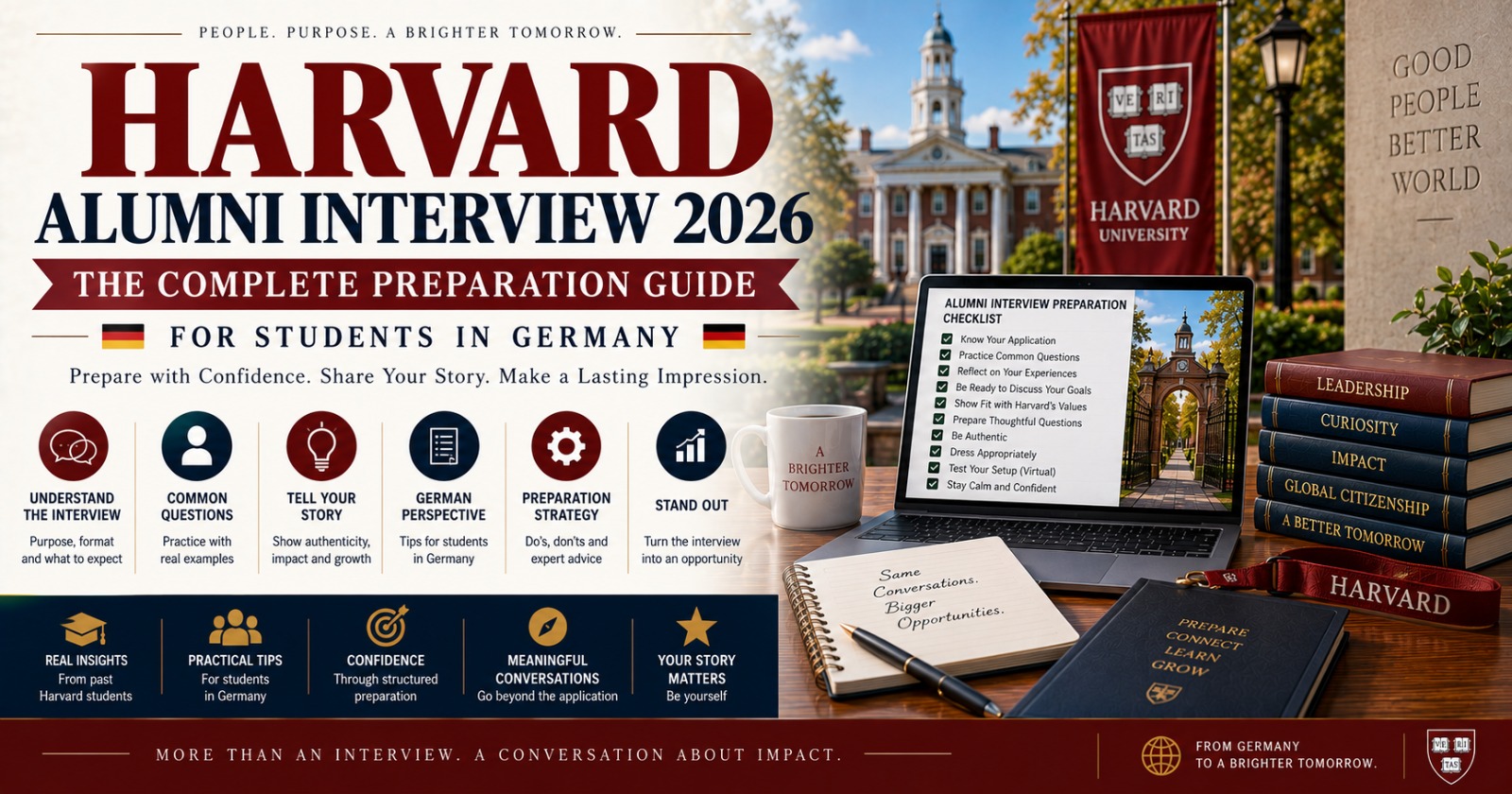
You have submitted your application. Then an email arrives that you may not have been expecting: Harvard would like to invite you for an alumni interview. Now what?
For many applicants from Germany at international schools or at Gymnasien the Harvard alumni interview is the least understood part of the application process, and simultaneously the most misunderstood. Some think it is decisive and can save or destroy everything. Others underestimate it entirely. Both are wrong.
As a Harvard graduate who went through this process myself and understands the interview from the inside, I want to give you a clear, honest guide: how the Harvard alumni interview works, what your interviewer evaluates, what questions you should expect, how to prepare concretely and what separates a memorable conversation from a forgettable one.
Note: IMPORTANT FIRST: The Harvard alumni interview is not a required component of the application. If you are not offered an interview, this explicitly does NOT mean your application is weak. It depends primarily on alumni availability in your region. Harvard states clearly: your application will receive a full and thorough evaluation even without an interview.
What the Harvard Alumni Interview Is — and What It Is Not
The basic structure
The Harvard alumni interview is not conducted by Harvard staff or admissions officers. It is led by Harvard alumni graduates who volunteer as interviewers through the Harvard College Interviewing Program or local Schools and Scholarships Committees.
This means: your interviewer is not a professional evaluator. They are someone with a Harvard degree who is taking time to get to know you. The conversation is informal no fixed question script, no point-scoring, no prosecutorial style. It is a conversation. Approximately 45-60 minutes. Your interviewer writes a brief report afterward that will become part of your admissions file.
What the report evaluates
Harvard gives its alumni interviewers specific dimensions to attend to. Based on what is known from Harvard Admissions, the interview report focuses on:
- Intellectual curiosity — do you go beyond surface-level answers in conversation?
- Character and values — who are you as a person?
- Communication — are you talking WITH the interviewer or AT them?
- Self-awareness — do you understand why you do the things you do?
- Genuine engagement with ideas — do you actually care about things, or are you performing interests?
How decisive is it?
The interview is not decisive in the sense that it can save or sink a strong or weak application. Harvard phrases it themselves: the interview will most likely confirm your application. It adds a human dimension to the picture. In very close decisions, an exceptional interview report can tip the balance in either direction.
Treat it seriously, but not with paralysing anxiety. It is an opportunity, not an interrogation.
How the Interview Works in Germany
Format: In person, video or phone
In Germany, Austria and Switzerland, there are Harvard alumni active as interviewers but density is lower than in the US. Some applicants in Germany receive interviews in their city or region. Others are interviewed by video call or telephone. All three formats are equivalent and treated identically by Harvard.
If you interview by video: test camera and microphone in advance. Stable internet connection. Quiet, tidy background. Dress as you would for an in-person conversation. The format is informal but you are representing yourself.
Timeline: When does the interview happen?
| REA applicants (November 1, 2026 deadline) | Interview typically November-December 2026, before the December decision |
|---|---|
| RD applicants (January 1, 2027 deadline) | Interview typically January-February 2027, before the March decision |
| Initiative lies with Harvard | You cannot request an interview Harvard contacts you |
| No interview received? | Not a sign of a weak application only alumni availability |
Typical Harvard Interview Questions — and How to Actually Answer Them
Your interviewer has no mandatory question list. But there are patterns categories that almost all Harvard interviews draw from. Here they are with an honest assessment of what is really being asked:
Opening questions — Who are you?
- ‘Tell me about yourself’ not a resume recitation, but 2-3 minutes that show what matters most
- ‘What would you want me to know about you that is not in your application?’
- ‘How would you describe yourself to someone who has never met you?’
What is behind this: the interviewer wants to see how you perceive yourself and what you consider meaningful. The worst answer is a chronological summary of your activities. The best answer opens a conversation it introduces something specific that makes the interviewer curious to hear more.
Intellectual curiosity — What genuinely engages you?
- ‘What subject or topic do you find yourself thinking about outside of school?’
- ‘What was the most interesting class you took this year and what made it interesting?’
- ‘What is the last book you read that genuinely changed how you think about something?’
- ‘What problem would you most like to solve?’
What is behind this: Harvard wants students who love ideas not students who love performance. The question is not which class you scored best in. It is what topic you cannot stop thinking about. Answer concretely. Not ‘I am interested in science’ but ‘I have been thinking a lot lately about the Fermi Paradox, because…’
Past and growth — What has shaped you?
- ‘What experience has most shaped who you are today?’
- ‘Tell me about a challenge you faced and what you learned from it’
- ‘What is something you failed at and what did you do with that failure?’
- ‘What decision are you most proud of?’
What is behind this: self-reflection. Harvard wants to see that you do not just experience things you ask yourself what they mean. Answer specifically one concrete situation, not a general growth statement. And avoid the cliche failure-essay structure: problem, struggle, triumph, lesson. Genuine reflection is more complex and more honest than that.
Harvard-specific — Why Harvard?
- ‘Why Harvard specifically?’
- ‘What do you hope to get from Harvard that you could not get elsewhere?’
- ‘What would you contribute to the Harvard community?’
What is behind this: do you actually know what Harvard is? Or does it sound like every other Ivy League application? Answer with a concrete, genuine connection a specific programme, a professor, a House system, a resource, an intellectual community that you understand and have thought about. ‘Harvard is the best university in the world’ is not an answer.
Future and direction — Where are you going?
- ‘What do you want to study at Harvard and why?’
- ‘Where do you see yourself in ten years?’
- ‘What do you want to do with your life?’
What is behind this: no expectation of a perfect plan. Harvard knows plans change. What the interviewer wants to see is a direction that comes from a genuine reason not prestige, not parental expectation, but a real interest in something that has been building for a while.
Closing questions — You ask back
Almost every Harvard interview ends with: ‘Do you have any questions for me?’ This is not polite filler time. It is your opportunity to engage as an equal and to show that you are genuinely interested in what the interviewer has experienced.
- ‘What surprised you most about your time at Harvard?’
- ‘What would you do differently if you were applying today?’
- ‘What is something about Harvard that is hard to understand from the outside?’
- ‘How has your Harvard degree influenced your life in a way you did not expect?’
Avoid questions you could have answered with a Google search: acceptance rate, tuition, majors. These show you are not genuinely curious but performing obligatory interest.
Concrete Preparation — What You Do in the Weeks Before
If you are preparing for Harvard from Germany, the interview should be viewed as one part of your overall admissions strategy rather than as an isolated step. A strong application requires careful planning across university selection, profile development, essays, recommendations and interviews. ARC Consultancy’s University Admissions Consulting provides personalised guidance across these stages, including structured interview preparation.
Weeks 1-2: Brainstorming and material gathering
- Write a list of 8-10 experiences, moments or topics you find meaningful without censoring
- Identify for each: what did this do to you? What did you learn or change because of it?
- Prepare 2-3 ‘anchor themes’ topics you can always return to regardless of how a question is framed
- Research Harvard specifically: note 2-3 concrete things programmes, professors, resources that genuinely interest you
If you are still building your overall Harvard application strategy, you can also read How to Get Into Harvard from Germany: The Complete 2026 Guide for broader guidance on the admissions process.
Weeks 2-3: Mock interviews
The only method that genuinely works: real practice conversations, in real time, out loud, with someone who actually listens and gives feedback. Not in front of a mirror. Not in your head. Out loud, in English, with a person.
This is also one of the areas covered by ARC Consultancy’s admissions consulting services, which include structured mock interviews based on first-hand experience with Harvard alumni interviews and Oxford interviews.
After each mock interview, ask yourself:
- Did I sound like myself or like someone playing a role?
- Did I answer the question or talk past it?
- Was the answer specific or generic?
- Did the answer open a conversation or close it?
Day of the interview
- 5 minutes early not excessively early, not late
- Dress code: business casual no suit required, but neat and respectful
- Phone on silent. Your questions for the interviewer written down
- Remember: this is a conversation between two people not an interrogation
The Critical Distinction: Conversation vs. Performance
This is the most important distinction for the Harvard interview. The biggest mistake applicants make: they prepare answers and deliver those answers regardless of what is asked. This feels robotic to the interviewer and signals exactly the opposite of intellectual curiosity.
A good Harvard interview is a conversation. The interviewer says something, you genuinely respond. You ask a follow-up question. They answer. You actually think. This is living curiosity and this is exactly what the interview report conveys back to Harvard.
Prepare themes, not scripts. Know yourself well enough to talk about anything. Come with genuine interest in the person sitting across from you not just the report they will write afterward.
Ivy League Interviews Compared — Harvard, Princeton, Yale
| Harvard | Alumni interviewer from local network. File-blind (interviewer does not see application materials). Informal. 45-60 min. Report goes into file. |
|---|---|
| Princeton | Alumni Schools Committee (ASC) generally considered more influential than Harvard interview. Interviewer may see more of your file. More structured. |
| Yale | Alumni interviews similar to Harvard. Not every applicant receives an interview. |
| Columbia | No regular alumni interview programme for undergrad. |
| MIT | No standard interview programme for undergrad. |
Frequently Asked Questions
What if I do not receive a Harvard interview?
Nothing negative. Harvard is clear: no interview is no disadvantage it is a function of alumni availability in your region, not a reflection of application quality. Focus on the rest of your application and do not draw conclusions from the absence of an interview.
What language is the Harvard interview conducted in?
Always English, including for international applicants. Accent-free English is not required but fluent, communicative English is essential. This is one of the reasons why practising in English before the interview is non-negotiable.
Should I research my interviewer?
Yes briefly and sensibly. LinkedIn, any public profile pages. Know their Harvard degree and professional background. This helps you ask better questions and find genuine connection points. No more than 20 minutes of research the goal is context, not comprehensive profiling.
Is the Harvard interview the same for IB students at international schools?
Yes. The format is identical regardless of whether you are applying from a German Gymnasium, an international school, or anywhere else in the world. The alumni interviewer may or may not be familiar with the IB curriculum specifically but the conversation is about you as a person, not about your curriculum. Your IB background can be a natural topic, but the interview does not require any IB-specific knowledge from either side.