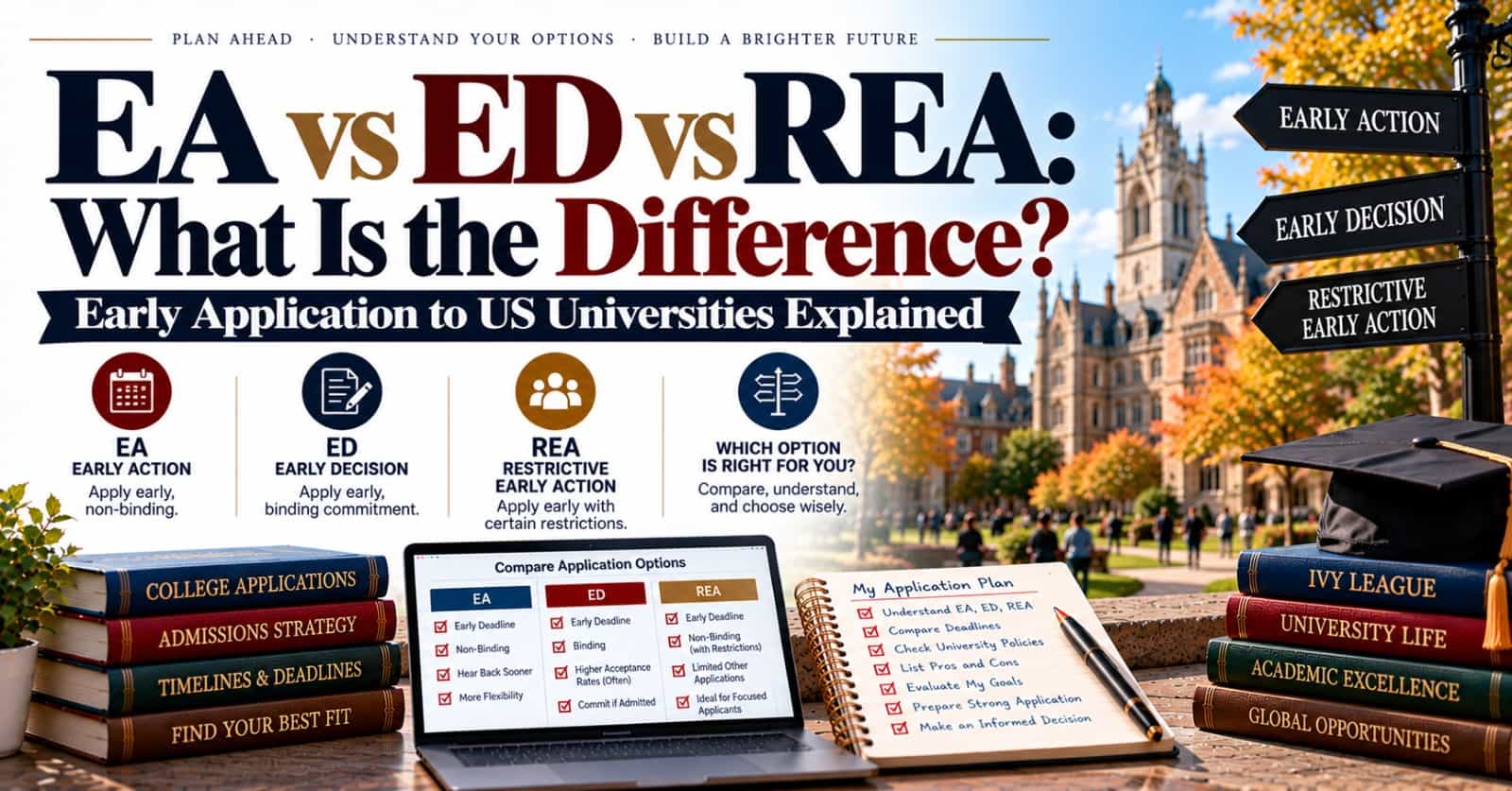
Applying to US universities means making one of the most important strategic decisions early: in which round do I apply? Early Action, Early Decision, or Regular Decision? And if Harvard, Yale, Princeton, or Stanford is the target: what does REA/SCEA mean for other applications?
This decision can significantly affect admission chances. This guide explains all application rounds, their differences, their deadlines, and when each is strategically appropriate. For a more detailed comparison, read our guide to Early Action vs Early Decision for students applying to US universities from Germany.
The Four Application Rounds at a Glance
There are four main rounds: Regular Decision (RD), Early Action (EA), Early Decision (ED), and Restricted Early Action (REA/SCEA).
Regular Decision (RD)
- Deadline: Usually 1 January (some universities: 15 January or 1 February)
- Decision: March/April
- Binding? No, you may wait until 1 May and then decide
- Multiple applications? Yes, unlimited
- Strategic disadvantage: Lowest acceptance rate, as all applicants compete in the same pool
Early Action (EA)
- Deadline: Usually 1 November
- Decision: December/January
- Binding? No, you receive an earlier decision but are not required to commit
- Multiple EA applications? Yes (with REA/SCEA restrictions)
- Strategic advantage: Earlier certainty, slightly higher acceptance rate, no commitment required
- Offered by: MIT, Georgetown, University of Michigan, UNC, Notre Dame, and many others
Early Decision (ED)
- Deadline: Usually 1 November (ED I) or 1 January (ED II)
- Decision: December (ED I) or February (ED II)
- Binding? YES, if admitted, you MUST commit and withdraw all other applications
- Multiple ED applications? No, only one ED application at a time
- Strategic advantage: Significantly higher acceptance rate (approximately 2-4x RD)
- Risk: No opportunity to compare financial aid offers, you accept the first offer
- Offered by: Penn, Columbia, Duke, Cornell, Brown, Dartmouth, Northwestern, NYU, Emory, and many others
Restricted Early Action / Single Choice Early Action (REA/SCEA)
- Deadline: 1 November
- Decision: December
- Binding? No, but with significant restrictions
- Offered by: Harvard (SCEA), Yale (REA), Princeton (SCEA), Stanford (REA)
- Restriction: No parallel EA or ED at other private US universities
- Permitted: Public US universities (e.g. University of Michigan EA), international universities (e.g. Oxford, ETH Zurich), rolling admission
Early Decision: When Does It Make Strategic Sense?
Early Decision makes sense when you are absolutely certain: this university is my first choice, and I would be prepared to attend regardless of the financial aid offer.
That is a high threshold. In practice, ED is particularly suited to applicants who:
- Know their clear first choice and have no need to compare financial aid packages
- Have family financial support independent of scholarship offers
- Are in a particularly competitive field where the additional “commitment signal” effect of ED matters
ED acceptance rates vs. RD: Concrete numbers
- Penn (overall ~5.9%) → ED ~15-20%, RD ~4%
- Columbia (overall ~3.9%) → ED ~10-12%, RD ~3%
- Dartmouth (overall ~6.2%) → ED ~20-25%, RD ~4%
- Brown (overall ~5.1%) → ED ~15%, RD ~4%
- Duke (overall ~6.4%) → ED ~17%, RD ~5%
The difference is not marginal, it is substantial. For the right application, ED can be the decisive variable.
ED risks for applicants from Germany
The greatest risk: you are admitted, but the financial aid offer is insufficient. Technically, you can withdraw from an ED commitment if the offer does not meet your demonstrated financial need, but this is a grey area. Discuss this before applying with ARC Consultancy. Learn more about ARC Consultancy’s university admissions consulting for personalised application planning and guidance.
REA/SCEA at Harvard, Yale, Princeton, and Stanford
Harvard, Yale, Princeton, and Stanford use REA/SCEA, a non-binding early application with restrictions on parallel applications.
What is NOT permitted under REA/SCEA
- EA or ED applications at other private US universities (e.g. MIT, Georgetown, Duke, Penn)
- All restrictions apply simultaneously, not sequentially
What IS permitted under REA/SCEA
- Applications to public US universities (University of Michigan, UNC, UT Austin) in EA rounds
- Applications to international universities (Oxford, Cambridge, ETH Zurich, LMU Munich)
- Rolling admission at US universities (e.g. University of Pittsburgh)
- Regular Decision at all other universities
Strategic choice: Harvard REA vs. Penn ED
This is one of the most common questions ARC Consultancy receives from German applicants: should I apply to Harvard under SCEA, or to Penn under ED?
The answer: if Harvard is your genuine first choice and your profile is competitive for Harvard, SCEA. If Harvard is a reach and Penn is a realistic first choice, Penn ED gives you substantially better admission odds at Penn while leaving RD at Harvard open. The right call depends on the individual profile. ARC Consultancy analyses this as part of application strategy.
ED II: The Second Early Decision Round
Early Decision II offers a second opportunity for binding early admission, typically with a 1 January deadline and February decision.
ED II is ideal for applicants who were not admitted in ED I and now have a clear second choice, or who did not know their first choice definitively until after November and are now certain.
- Offer ED II: Vanderbilt, Tulane, Boston University, Emory, American University, NYU, Carnegie Mellon, and many others
- ED II deadline: 1 January at most universities
- Decision: February, sometimes earlier
- ED II acceptance rate: Also significantly higher than RD, but usually slightly lower than ED I
Deadline Overview 2025-2026
November deadlines (early rounds)
- 1 November: EA and ED I at most universities; REA/SCEA at Harvard, Yale, Princeton, Stanford
- 15 November: EA at some universities (MIT, Georgetown)
December: Decisions
- December: ED I and REA/SCEA decisions released (typically 15-20 December)
- Important: On admission under ED I or deferral to RD, you must respond accordingly
January deadlines (Regular Decision & ED II)
- 1 January: RD deadline at Harvard, Yale, Princeton, Stanford, Columbia, Brown, Dartmouth, and many others
- 1 January: ED II deadline at most universities offering ED II
- 1 February: RD deadline at some universities (Georgetown, Tulane)
Spring decisions
- Mid-March to April: Regular Decision notifications released
- 1 May: National Reply Date, deadline to decide and pay enrolment deposit
Applying Early from Germany: Important Notes
The same rules apply to applicants from Germany, with one important consideration: time zone differences and transcript timing.
All US application deadlines are in US Eastern Time (ET), that is Central European Time minus 6 hours (winter). A deadline on 1 November at 23:59 ET corresponds to 2 November at 05:59 CET.
Abitur and application timing
Students sitting the Abitur in Germany in June 2026 apply for the Fall 2026 entry term (September 2026). For the Fall 2027 entry term, ED/EA deadlines fall on 1 November 2026, you are still in the Qualifikationsphase. Your preliminary grades (Jahreszeugnis from Q1 or Q2) are submitted.
For personalised guidance on application planning, university selection, and deadlines, explore ARC Consultancy’s university admissions consulting services.
Frequently Asked Questions
What is the difference between EA and ED?
EA (Early Action) is non-binding. ED (Early Decision) is binding, if admitted, you must commit and withdraw all other applications.
What is REA?
Restricted Early Action, non-binding but with restrictions on parallel EA/ED applications at other private US universities. Harvard and Princeton call it SCEA.
Does Early Decision increase admission chances?
Yes, typically 2-4x higher acceptance rate in ED than in RD. Strategically highly relevant, but only when the university is your clear first choice.
When is the Early Decision and Early Action deadline?
Usually 1 November. REA/SCEA at Harvard, Yale, Princeton, Stanford: also 1 November. RD: usually 1 January.
Can I apply Early Action to multiple universities?
Yes, standard EA permits parallel applications. Exception: with REA/SCEA (Harvard, Yale, Princeton, Stanford), EA at other private universities is not permitted.