
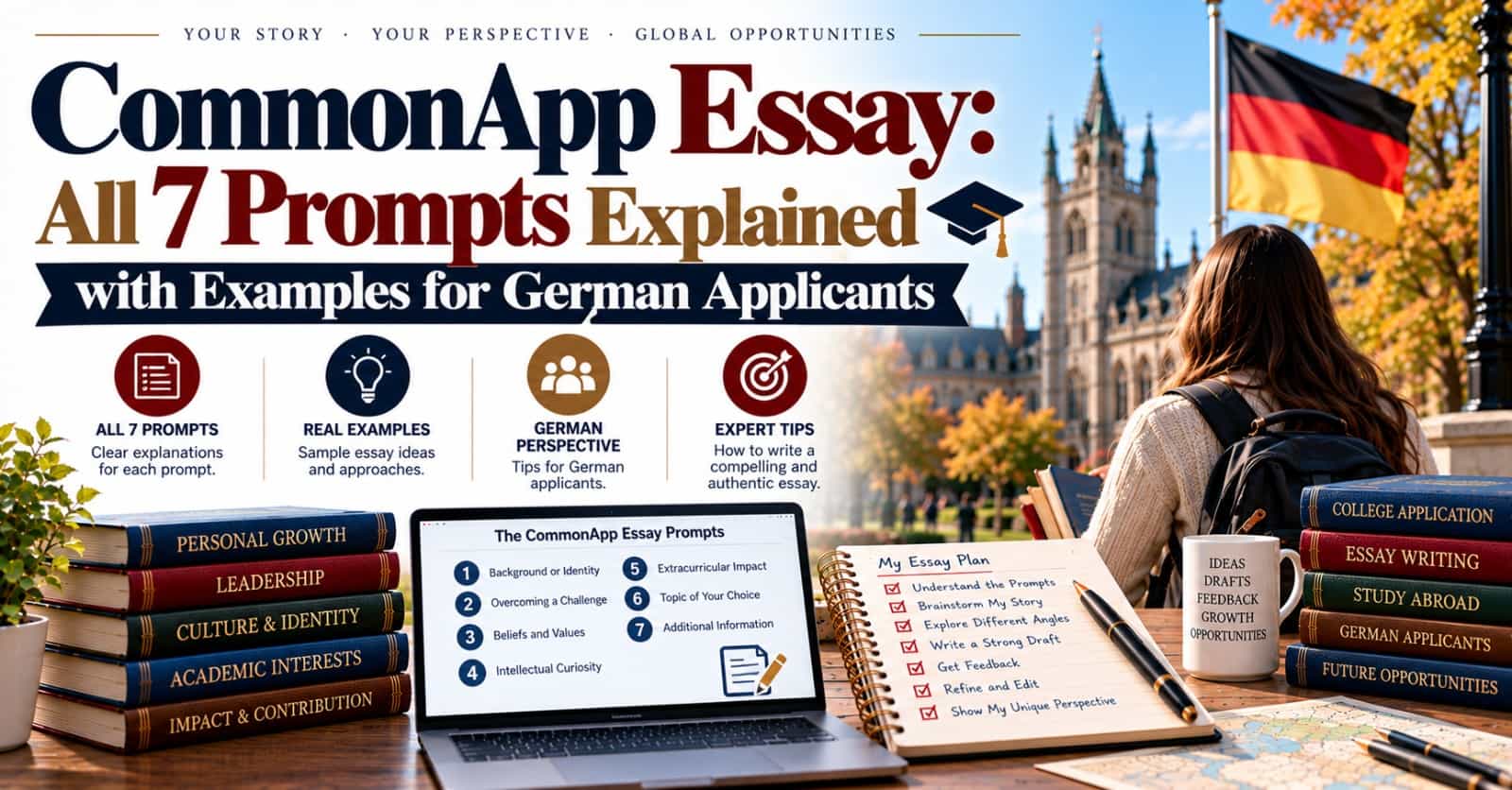
The CommonApp essay, also called the Personal Statement, is the centrepiece of every US university application. It is the only part of the application where you speak entirely in your own words. No form, no grades, no activity list, just you and your story.
That is precisely the challenge: many applicants from Germany are excellent students and accomplished high-achievers, but unaccustomed to condensing their story into 650 words and telling it in a way that lets an admissions officer understand, in eight minutes, who they genuinely are.
This guide explains all 7 CommonApp prompts for 2025-2026, shows common mistakes, and gives you a clear foundation for your own essay. For additional inspiration, explore these CommonApp essay topics and examples.
What the CommonApp Essay Must Achieve and What It Must Not
The CommonApp essay must show something that does not come through anywhere else in your application: how you think, what matters to you, and who you are as a person.
What a Good CommonApp Essay Is NOT
- A CV in prose form (“I am a Year 12 student with the following activities…”)
- A list of prizes and achievements (“I won the maths olympiad and am top of my class…”)
- A German-style motivation letter (“I am applying to Harvard because…”)
- An essay about a famous person or global issue with no personal connection
- A story that only shows how impressive you are, without depth, reflection, or vulnerability
What a Good CommonApp Essay IS
- A concrete, specific story from your life, often small and personal, not epic
- A window into how you think, feel, solve problems, or see the world
- An essay that leaves the reader feeling: “I know this person now”
- Authentic in voice and tone, not what you think Harvard wants to hear
The 7 CommonApp Essay Prompts 2025-2026 Explained
The 7 prompts have been stable since 2023. Here they are with strategic notes for applicants from Germany. You can also read our guide to CommonApp essay prompts for more guidance on choosing a suitable prompt.
Prompt 1: Background, Identity, Interest, or Talent
“Some students have a background, identity, interest, or talent that is so meaningful they believe their application would be incomplete without it. If this sounds like you, then please share your story.”
The most frequently chosen prompt, and the most frequently misinterpreted. This is not an invitation to write a Wikipedia article about your heritage. It asks for something specific that is so central to you the application would be incomplete without it.
When Prompt 1 Is Right
- You have a background or cultural identity that genuinely explains everything else in your application
- You have a talent or interest (music, language, sport, art) so formative it has shaped how you see the world
- You come from Germany and have a story that makes your bilingualism, internationality, or cultural position meaningful
Common Mistake
Generic cultural pride essays without a specific, personal story. “I am proud of my German heritage because Germany has…” That is not a Personal Statement.
Prompt 2: Overcoming a Challenge or Setback
“The lessons we take from obstacles we encounter can be fundamental to our later success. Recount a time when you faced a challenge, setback, or failure. How did it affect you, and what did you grow to learn or understand?”
Popular but risky: this prompt invites “trauma narrative” or an overwrought hero story. Strong versions are honest, concrete, and reflective, showing not only that you overcame a challenge but how you thought and what you learned in the process.
Common Mistake
The challenge dominates the essay (500 of 650 words description, 150 words reflection). Reverse the ratio: 30% challenge, 70% reflection and growth.
Prompt 3: Questioning a Belief or Idea
“Reflect on a time when you questioned or challenged a belief or idea. What prompted your thinking? What was the outcome?”
This prompt tests intellectual courage and critical thinking, qualities Ivy League admissions officers explicitly seek. Less popular, but highly effective for intellectually bold applicants.
Common Mistake
Overly political or controversial positions that risk alienating admissions officers. Choose a topic that touches you personally, not a global flashpoint.
Prompt 4: Gratitude and a Surprising Act of Kindness
“Reflect on something that someone has done for you that has made you happy or thankful in a surprising way. How has this gratitude affected or motivated you?”
Rarely used, and therein lies its advantage. It tests emotional intelligence and the ability to acknowledge others. Admissions officers see few essays on this prompt and will be genuinely surprised.
When Prompt 4 Is Right
- There is a person, a parent, teacher, friend, or stranger, whose gesture genuinely changed something in you
- The story is concrete, warm, and reveals depth of character
Prompt 5: Personal Growth and New Understanding
“Discuss an accomplishment, event, or realization that sparked a period of personal growth and a new understanding of yourself or others.”
Similar to Prompts 1 and 2, but focused specifically on growth and newly gained self-understanding. Resist listing achievements. Show the specific moment of recalibration, the instant your self-understanding shifted. That is more interesting than the outcome.
Prompt 6: A Captivating Topic or Concept
“Describe a topic, idea, or concept you find so engaging that it makes you lose track of time. Why does it captivate you? What or who do you turn to when you want to learn more?”
Excellent for applicants with strong intellectual curiosity and a clearly defined academic interest. This prompt tests whether you are as passionate about a subject as your application implies. Avoid: “I am interested in medicine because I want to help people.” Show the specific question or problem you cannot stop thinking about.
Prompt 7: Topic of Your Choice
“Share an essay on any topic of your choice. It can be one you’ve already written, one that responds to a different prompt, or one of your own design.”
Maximum freedom, and maximum responsibility. Ideal when your best story does not fit any of the other six prompts. Popular for unconventional, creative essays, an object, a place, a routine, a metaphor as the entry point into a personal story. Prompt 7 gives you the format, not the topic. Write the essay first, then assign the prompt.
Common Mistakes in the CommonApp Essay
Admissions officers read thousands of essays per season. Certain patterns are immediately recognisable and weaken any application.
- Mistake 1: The “Mission Trip” essay: I went to Africa/South America and my life changed. Avoid almost universally. Appears self-centred and clichéd.
- Mistake 2: The generic “immigrant/foreigner” essay: Your background is interesting, but only with a concrete, personal story, not a general statement.
- Mistake 3: The sports achievement essay: I won/lost the final and learnt teamwork. Admissions officers see this hundreds of times per season.
- Mistake 4: The “I want to be a doctor” essay: My grandmother was ill, so I want to study medicine. Only works with a genuinely unusual, deeply personal story.
- Mistake 5: The over-achievement essay: A prose list of all activities and prizes. That is what the Activities section is for.
- Mistake 6: Too polished, too perfect: If the essay sounds as though a teacher wrote it, it is no longer a Personal Statement. Authenticity beats perfection.
The Essay Writing Process: Step by Step
A strong CommonApp essay is not written in one night. It is developed across several phases. If you need structured guidance throughout your university application, ARC Consultancy offers admissions support tailored to students applying to universities in the US and other countries.
Phase 1: Brainstorming (1-2 Weeks)
List 10-20 moments, experiences, people, or objects that matter to you. Do not filter yet. Write everything down. Then: which 3 stories would give the clearest picture of you in 650 words?
Phase 2: Prompt Selection
Select the prompt based on your best story, not the other way around. Think of Prompt 7 as a last resort, but write the essay first and assign a prompt afterwards.
Phase 3: First Draft, Skip Perfection
Write your first draft as quickly as possible. It will not be good, that is fine. The first draft exists to find out what the story actually is.
Phase 4: Structural Feedback
Ask yourself: is the focus clear? Do I show who I am? Is there too much context and too little reflection? Revise structure before revising language. For professional guidance, see ARC’s essay brainstorming and feedback support.
Phase 5: Language Revision
Only after several structural rounds: language, tone, specificity, opening sentence, closing. A strong opening sentence pulls the reader in immediately. A strong close connects back to the opening or opens a new perspective.
Phase 6: Final Review
Read aloud. Does it sound like you? Are all words necessary? Have you used the word limit (620-650 words)? Have someone who knows you well read it, and someone who does not.
Frequently Asked Questions
Which CommonApp Essay Prompt Is Best?
There is no “best” prompt. Choose the one that enables your most compelling story. Prompt 7 is the most flexible.
How Long Should the CommonApp Essay Be?
Maximum 650 words. Aim for 620-650. Under 500 appears incomplete.
Can I Write the CommonApp Essay in German?
No, it must be in English. Your English does not need to be perfect, but should be clear and authentic.
What Should I Write in the CommonApp Essay?
A concrete, personal story that shows who you are and how you think, not a CV in prose form.
How Many Revisions Does a Strong CommonApp Essay Take?
Typically 3-7 revision rounds. The first draft is rarely strong enough, so plan the time.