
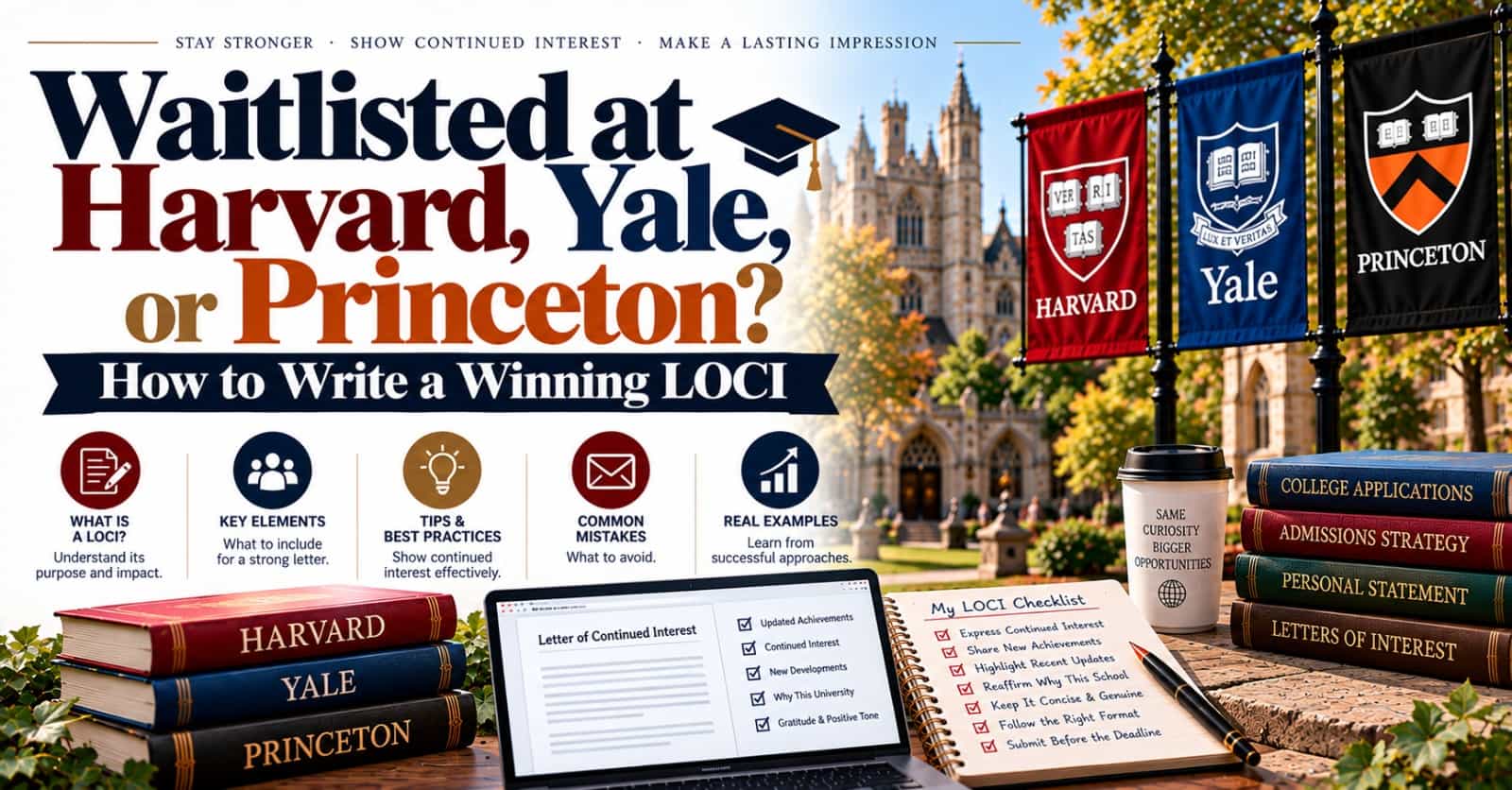
Direct Answer: A LOCI (Letter of Continued Interest) is a 250–400-word letter submitted after being waitlisted. It confirms your continued interest, shares meaningful updates, and explains why the university remains your first choice. Submit it as soon as possible, ideally within 2–5 business days of receiving your waitlist notification, through the institution’s designated portal or preferred communication channel.
Being waitlisted is simultaneously frustrating and hopeful. You were not rejected, but you were not admitted either. Now, the question is: What can you actually do to maximise your chances?
The answer is a LOCI, or Letter of Continued Interest. This guide explains what a LOCI is, how to write one, how to submit it, and what waitlist admission chances at Harvard, Yale, and Princeton really mean.
What Is a LOCI?
A LOCI (Letter of Continued Interest) is a letter you submit after receiving a waitlist notification to confirm your ongoing interest in a university and share important updates since submitting your application.
Universities like Harvard, Yale, and Princeton place applicants on their waitlists because they may be qualified for admission, but the university cannot offer a place to everyone in the initial admission round. A well-written LOCI can help admissions officers understand your continued interest and consider relevant developments in your application when reviewing the waitlist.
What a LOCI Is Not
A LOCI should be concise, professional, and focused on new information. It is not:
- Another application essay: Do not write a lengthy narrative that repeats everything in your original application.
- A request for a decision review: Asking the admissions committee to reconsider its decision is unlikely to help.
- An argument about why you deserve admission: Avoid suggesting that you are more deserving than other applicants.
- An additional application package: Do not attach a CV, extra recommendation letters, or a portfolio unless the university explicitly requests them.
What to Include in Your LOCI
A compelling LOCI contains four essential elements: confirmation of continued interest, meaningful updates, specific reasons for choosing the university, and, when appropriate, a clear statement that you would accept an offer.
1. Confirm Your Continued Interest
Start with a clear, direct, and measured statement of interest.
Avoid exaggerated language such as, “I would give my right arm to attend this university.”
Instead, write something like:
“I am writing to confirm my continued interest in [University Name] and to share a few meaningful updates since submitting my application.”
If the university is genuinely your first choice, you can state that explicitly. Your opening should sound sincere and professional rather than overly emotional.
2. Share Meaningful Updates Since Your Application
Updates are among the most valuable elements of a LOCI. Focus on achievements, developments, or academic progress that occurred after you submitted your original application.
Examples of meaningful updates include:
- New awards or distinctions: Recognition in competitions such as the Bundeswettbewerb or qualification for an academic Olympiad.
- Improved academic performance: Stronger grades, particularly new Abitur semester results.
- Research or published work: Progress on a research project, a publication, or a significant independent academic undertaking.
- Leadership and extracurricular achievements: A new leadership position or measurable impact through an existing activity.
- Admission to significant organisations: Selection for programmes or organisations such as the Studienstiftung or Bundesjugendorchester, where relevant.
Focus on developments that demonstrate intellectual curiosity, initiative, personal growth, or sustained commitment.
What If You Have No New Achievements?
You can still write a LOCI even if you have no major updates. Do not invent achievements or exaggerate minor developments to fill the letter.
Instead, devote more attention to explaining why the university remains a strong fit for your academic interests and long-term goals. Share genuine reflections or specific insights that add value beyond your original application.
3. Explain Why This Specific University Remains Your Choice
Your LOCI should demonstrate a clear understanding of the university and why you want to study there specifically.
Avoid generic statements such as, “I want to attend because of the world-class education and renowned faculty.”
Instead, include concrete details that connect your academic interests to the university’s offerings.
For example:
- “I have continued following Professor [Name]’s research on [specific subject], and I hope to explore related questions through my undergraduate studies.”
- “The structure of [specific programme] aligns closely with my interest in [academic field] and offers opportunities that are particularly relevant to my goals.”
- “After speaking with current students involved in [specific student organisation], I gained a clearer understanding of the academic community I hope to join.”
Only mention professors, research opportunities, programmes, or student organisations that you have genuinely researched. Specificity is more persuasive when it reflects authentic interest rather than name-dropping.
4. Include a Yield Statement If Appropriate
If Harvard, Yale, or Princeton is genuinely your first choice and you would accept an offer from the waitlist, consider stating that clearly.
For example:
“I would be delighted to accept an offer of admission from the waitlist if one becomes available.”
Only make this commitment if it is true. Do not claim that you would definitely enrol if you are still deciding between universities.
A credible statement of intent can help the admissions committee understand your plans, but it does not guarantee admission or provide a substitute for academic and personal fit.
When and How to Submit Your LOCI
Submit your LOCI promptly after receiving your waitlist notification, ideally within 2–5 business days if you have meaningful information to share. However, always follow the university’s official instructions and deadlines rather than treating this timeframe as a formal admissions rule.
How to Submit a LOCI to Harvard
Harvard releases regular admission decisions in the spring, and waitlisted applicants should follow the instructions provided with their decision.
- Confirm your place on the waitlist using the method specified by Harvard.
- Review the applicant portal for instructions about additional updates or correspondence.
- Submit your LOCI through the designated channel, if permitted.
- Keep the letter concise and focus on significant developments since your application.
Do not assume that Harvard accepts LOCIs through every portal or email channel. Follow the current instructions provided directly to applicants.
How to Submit a LOCI to Yale
Yale applicants should follow the instructions included in their waitlist notification and the Yale Admissions portal.
- Confirm your waitlist status as instructed.
- Check whether Yale requests additional information or provides specific guidance about updates.
- Submit your LOCI using the designated portal or communication method.
- Avoid sending duplicate letters through multiple channels.
If Yale provides specific instructions about what to include, prioritise those requirements over general LOCI advice.
How to Submit a LOCI to Princeton
Princeton applicants should consult their waitlist notification and the Princeton applicant portal for the appropriate submission process.
- Confirm your intention to remain on the waitlist.
- Review the university’s instructions regarding additional materials.
- Submit your LOCI through the permitted channel.
- Provide relevant updates if your academic or extracurricular circumstances change.
Waitlist activity and timelines can vary by admission cycle. Do not assume that the waitlist will remain active until a particular date unless Princeton confirms it.
Ideal LOCI Length and Format
Keep your letter focused and easy to read.
- Length: Approximately 250–400 words, unless the university specifies otherwise.
- Format: A professional letter or email.
- Content: Continued interest, meaningful updates, university-specific reasons, and an acceptance statement if appropriate.
- Attachments: Include them only when explicitly requested or permitted.
- Proofreading: Check spelling, grammar, names, programme details, and contact information before submitting.
The goal is to communicate important information efficiently, not to produce the longest or most emotional letter.
What Are Your Waitlist Odds at Harvard, Yale, and Princeton?
Waitlist admission at Harvard, Yale, and Princeton is highly unpredictable. Applicants should understand that admission is never guaranteed, even when their academic qualifications are exceptional and their LOCI is compelling.
Harvard Waitlist Admission Chances
Harvard’s waitlist outcomes can vary substantially from year to year. In some admission cycles, the university admits few or no applicants from the waitlist. In others, it may admit several dozen or more.
The number of applicants admitted depends on the size of the incoming class, the number of admitted students who enrol, institutional priorities, and other factors.
Yale Waitlist Admission Chances
Yale also experiences considerable variation in waitlist activity. The number of students admitted from the waitlist depends on enrolment patterns and the university’s needs for that particular admission cycle.
A strong LOCI may help communicate your continued interest, but it cannot predict whether Yale will have available places.
Princeton Waitlist Admission Chances
Princeton’s waitlist outcomes are similarly variable. The university may use the waitlist differently from one year to another, depending on how many admitted students accept their offers and the composition of the incoming class.
Applicants should avoid relying on a particular historical admission count as a forecast for the current year.
Why Waitlist Admission Rates Change Every Year
The main factor influencing waitlist activity is enrolment yield: the proportion of admitted students who choose to enrol.
If more students accept their initial offers than expected, the university may have little need to admit applicants from the waitlist. If fewer students accept, additional places may become available.
Other considerations may include institutional priorities and the composition of the incoming class.
For this reason, historical figures should be treated as context rather than reliable predictions. Consult official university publications for the most recent available data instead of relying on unverified estimates.
What Can Improve Your Waitlist Application?
Although no strategy guarantees admission, a thoughtful LOCI can help you present your continued interest clearly and professionally.
1. Confirm Your Interest Honestly
If you would accept an offer, say so clearly. Avoid making promises you cannot keep.
2. Provide Genuine Updates
Share relevant academic achievements, research progress, leadership developments, or other significant changes since submitting your application.
3. Demonstrate Specific University Fit
Explain how particular academic opportunities, programmes, or resources connect to your goals. Avoid generic praise that could apply to any university.
4. Follow the University’s Instructions
Respect submission requirements, deadlines, and restrictions on additional materials. A well-written letter will not help if it disregards the university’s stated process.
5. Consider Additional Recommendations Only When Appropriate
A supplementary recommendation may be useful if the university permits it and the letter offers genuinely new, relevant information. Do not send additional recommendations without checking the university’s policy.
What Does Not Improve Your Waitlist Chances?
Certain approaches can make your communication less effective or create unnecessary problems.
- Sending repeated follow-up messages: One thoughtful LOCI is generally preferable to multiple messages that repeat the same information.
- Pressuring admissions officers: Calls from parents or teachers demanding admission are unlikely to strengthen your application.
- Using emotional appeals without substance: Statements about how much you want admission are less informative than genuine updates and specific reasons for choosing the university.
- Repeating your original application: Your LOCI should add useful context rather than reproduce information admissions officers already have.
- Making false promises: Never claim that you will enrol if you would not actually accept an offer.
- Ignoring official instructions: Do not submit materials through unapproved channels or exceed stated limits.
How ARC Consultancy Can Help You Develop Your LOCI
ARC Consultancy supports applicants from Germany throughout the US university application process, including the critical period after admission decisions are released.
Its support can help students organise relevant updates, communicate their continued interest, explain their fit with a university, and navigate decisions involving multiple offers and waitlists.
If you have been waitlisted at Harvard, Yale, Princeton, or another highly selective university and want guidance on developing your LOCI, you can explore the following resources:
- Get in touch: https://arcconsultancy.de/en/contact/
Final Thoughts
Being waitlisted at Harvard, Yale, or Princeton can feel uncertain, but you still have an opportunity to communicate your continued interest professionally. A strong LOCI should be concise, specific, honest, and focused on meaningful updates.
Submit it through the university’s designated channel, respect all instructions, and continue planning around your confirmed admission offers while you wait for a final decision.
Most importantly, remember that a waitlist decision does not define your potential. Focus on the opportunities available to you and make an informed decision about your next academic step.
Frequently Asked Questions About LOCIs
What Is a LOCI?
A Letter of Continued Interest is a message sent after a university waitlists an applicant. It confirms continued interest, provides meaningful updates, and explains why the university remains a strong choice.
A letter of approximately 250–400 words is a useful starting point unless the university specifies a different format or length.
What Are the Odds of Getting Off Harvard’s Waitlist?
Harvard’s waitlist admission rate varies considerably from year to year. Some years see few or no waitlist admissions, while others produce more offers. Check official historical data for context, but remember that past outcomes do not guarantee future results.
What Should a LOCI Include?
A strong LOCI generally includes four elements:
- A clear statement of continued interest.
- Meaningful updates since submitting the application.
- Specific reasons for choosing that university.
- An honest statement that you would accept an offer, if applicable.
When Should I Submit My LOCI?
Submit it promptly after receiving your waitlist notification, ideally within 2–5 business days when possible. Follow the university’s actual deadline and submission instructions if they differ from this general recommendation.
Should I Write a LOCI If I Have Good Offers From Other Universities?
Yes, if the waitlisted university remains a genuine choice and you would seriously consider accepting an offer. If it is your first choice and you would enrol, you can say so directly.
You should also evaluate your existing offers carefully and meet their deadlines. A waitlist offer is uncertain, so do not give up a confirmed opportunity solely because you hope to receive an offer later.
Can a LOCI Guarantee Admission From the Waitlist?
No. A LOCI can communicate continued interest and provide relevant new information, but admission depends on available places and the university’s selection decisions. Even an excellent letter cannot guarantee an offer.
Should I Send More Than One LOCI?
Usually, one well-prepared letter is sufficient unless the university invites further updates or you have a significant new development to report. Follow the university’s instructions and avoid sending repeated messages without a clear purpose.
Is a LOCI Required for Harvard, Yale, or Princeton?
Requirements and preferences can vary by institution and admission cycle. Check your waitlist notification and the official admissions portal to determine whether a letter is encouraged, permitted, or unnecessary.