
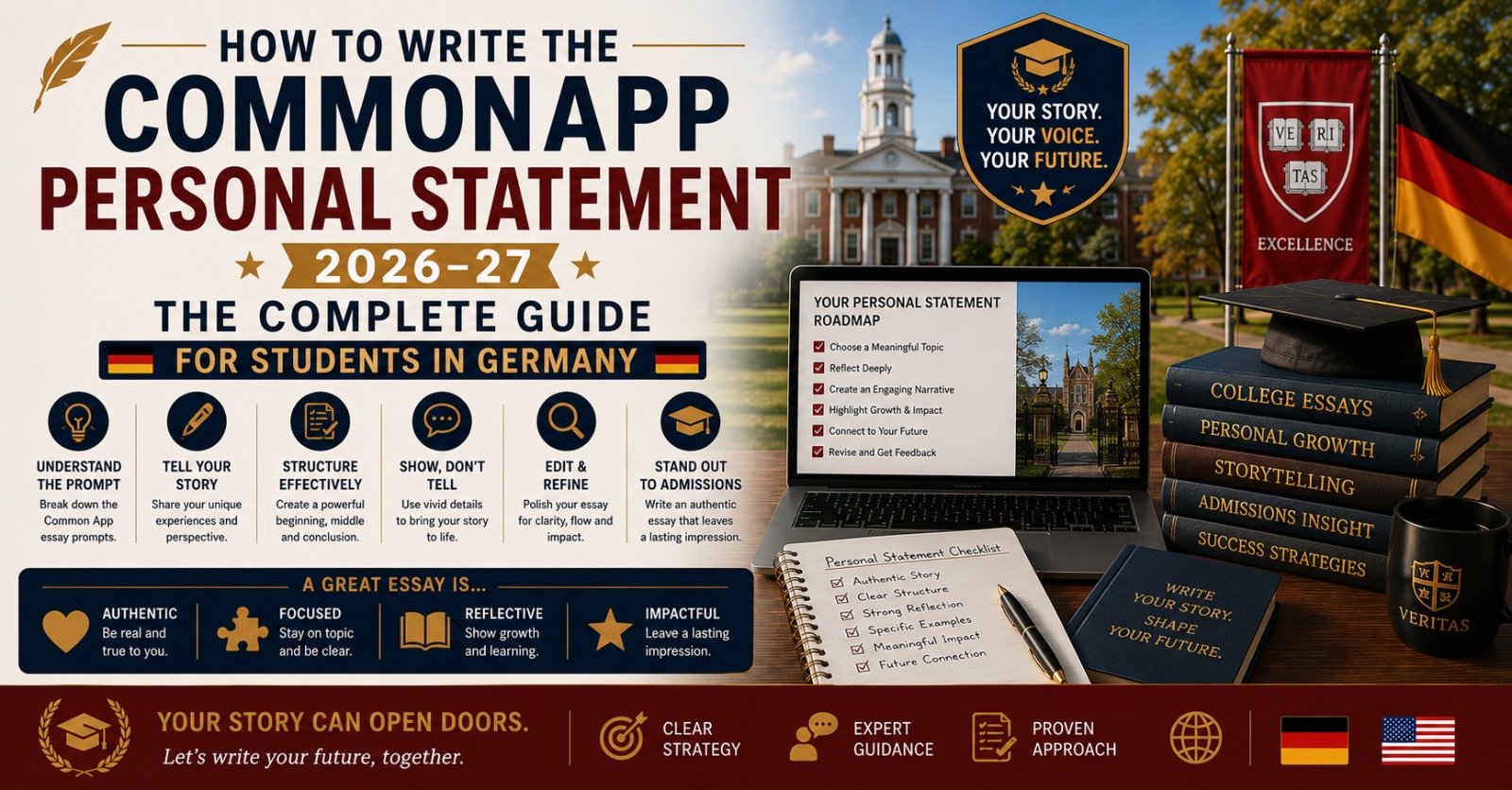
There is a moment almost every student applying to US universities from Germany knows: the cursor blinking on a blank document. 650 words. And the question: where do I start?
The CommonApp personal statement is the most important piece of writing in your entire application. It is the only element where you have complete control over what the admissions committee learns about you as a person. Grades, SAT scores and activity lists are numbers and facts. The essay shows who you are.
This guide gives you a complete method for writing your CommonApp personal statement from finding your topic through structure and revision. Written specifically for students in Germany, including those in IB programmes at international schools, who are writing in English about experiences shaped by a different educational context.
Hinweis: QUICK REFERENCE: CommonApp personal statement = your main essay, visible to ALL universities on your list — Length: 250-650 words (target 620-650) 7 prompts to choose from Opens August 1, 2026 for the 2026-27 cycle CommonApp confirmed: prompts are unchanged for 2026-27
What the Personal Statement Is — And Is Not
The personal statement is not a prose version of your resume. It does not list achievements or repeat what is already in other parts of the application.
What it does instead: it shows how you think. What genuinely matters to you. How you see the world. Who you will be when you arrive on a top university campus.
Admissions officers at Harvard, Yale and Princeton read thousands of personal statements. What stays with them are not essays about extraordinary achievements. They are essays where a real person with a real perspective speaks specific, authentic and unmistakably their own.
The 7 CommonApp Essay Prompts for 2026-27 — Confirmed Unchanged
The CommonApp officially confirmed on February 27, 2026 that the essay prompts remain the same for 2026-27. Here is what each is actually asking for:
Prompt 1: Background, Identity or Passion
Prompt: Some students have a background, identity, interest, or talent that is so meaningful they believe their application would be incomplete without it.
The most flexible prompt and the hardest to write without being generic. ‘I am a bilingual German student with an international perspective’ is not a story. ‘The moment I understood that a concept exists between two languages that neither can fully express’ is a story. The test: could only you have written this essay?
Prompt 2: Challenge, Setback or Failure
Prompt: The lessons we take from obstacles we encounter can be fundamental to later success.
Second most popular at 23% in 2025-26. The problem: nearly all challenge essays follow the same arc problem, struggle, resolution, lesson. What works: an essay that shows your reaction more than the challenge itself. Admissions officers are not interested in what happened to you they are interested in what you did with it.
Prompt 3: Questioning a Belief or Idea
Prompt: Reflect on a time when you questioned or challenged a belief or idea.
One of the least chosen at only 3% which means full of opportunity. For intellectually curious students from the German or IB educational tradition, this is excellent territory. When did you question something a scientific assumption, a social convention, a teacher’s view and what did that teach you?
Prompt 4: Gratitude and Surprise
Prompt: Reflect on something that someone has done for you that has made you happy or thankful in a surprising way.
The risk: an essay that focuses on someone else rather than yourself. If you choose this prompt, ensure the second half clearly shows what this experience reveals about YOU, your values, your way of seeing the world.
Prompt 5: Personal Growth
Prompt: Discuss an accomplishment, event, or realization that sparked a period of personal growth.
Popular at 20% in 2025-26. Admissions officers have read this structure many times. To stand out, the realisation must be specific and non-obvious not a gradual journey but a concrete turning point.
Prompt 6: Topic of Your Choice Most Popular at 28%
Prompt: Describe a topic, idea, or concept you find so engaging that it makes you lose all track of time.
28% of all CommonApp applicants chose this in 2025-26. Complete freedom is both liberating and dangerous ‘anything permitted’ often becomes ‘nothing particularly interesting.’
Prompt 7: Open Topic
Prompt: Share an essay on any topic of your choice it can be one you have already written, one that responds to a different prompt, or one of your own design.
Hinweis: The most important advice: find your STORY first. Choose the PROMPT after. The strongest essays typically fit multiple prompts simultaneously that is how you know the story is strong.
The 6-Step Method for Writing Your Personal Statement
Step 1: Brainstorming Finding the Right Story (2-3 weeks)
Most common question: ‘What should I write about? Nothing extraordinary has happened to me.’ That is a misunderstanding. The best personal statements come from small, specific moments a conversation, an object, a habit, a decision.
Brainstorming exercise for students in Germany:
- What do you do when no one is watching and no grade is given?
- Which book changed the way you think — and why this specific passage?
- Was there a moment at school when you taught yourself something not in the curriculum?
- What do you enjoy explaining to strangers — a topic, a system, an idea?
- Which decision from the past two years do you not regret even though it was difficult?
Your answers generate topic candidates. None is immediately the essay. All are raw material.
Step 2: Choosing the Topic — What Makes It Uniquely Yours?
A strong topic has three qualities: it could only have come from you. It has a concrete, specific core not a vague concept. And it opens a window into how you think, not just what you have experienced.
Avoid: sports-defeat-comeback essays, generic exchange essays, grandparent essays unless their story is directly connected to yours in a non-obvious way.
Step 3: First Draft — Write Without Judging
Write a complete first draft without self-censorship. The goal is not a good draft it is any complete draft that exists and can be edited. Ignore the 650-word limit for now.
Step 4: Check Structure — Hook, Core, Reflection, Forward Look
- Hook (first 1-3 sentences): Something that creates immediate curiosity. Not ‘In 2021 I realised…’ — more like a concrete image, dialogue or unexpected statement.
- Core: The specific moment with sensory detail. Show, do not explain.
- Reflection: What did that do to you? What did you understand that you did not before?
- Forward look: How does this connect to who you will be at university?
Step 5: Cut and Sharpen — 650 Words Is Enough
Read every sentence and ask: does the essay need this to tell the story? If the answer is ‘no’ or ‘possibly’ cut it. Focused essays that illuminate one thing precisely stay with the reader. Overloaded essays say very little.
Step 6: Get Feedback — From the Right Person
Show your essay to someone who will read it honestly. Test question: can they tell you five specific things about you after reading that could not have come from any other part of the application? If not, the essay needs to become stronger.
Specific Advice for Students in Germany
Your IB Extended Essay is excellent preparation
Students who have already written an IB Extended Essay have practised sustained intellectual writing at length. The skills transfer. The way you developed your EE argument identifying a focused research question, building a case, reflecting on what you found is directly relevant to how the best college essays are built.
Write in English but think in your first language
A CommonApp essay by a non-native English speaker can sometimes feel stiff not because of vocabulary but sentence structure. Strategy: think and brainstorm in your first language (German, or whatever yours is). Then write the first draft in English. This gives you the authenticity of your natural thinking style with the English expression.
AI tools in 2026 what is and is not permitted
The CommonApp and Ivy League universities clarified in 2026: AI tools may be used for brainstorming and grammar checking. They may not write or substantially rewrite the text. Style, word choice and structure must come entirely from you. AI-generated essays are identifiable and violating this rule can result in immediate disqualification.
Frequently Asked Questions
Should I write about my experience as a student in Germany?
Absolutely and it is often a genuine strength. But not because Germany or the Abitur is inherently impressive to American admissions officers. It is because your specific perspective from that context may be genuinely unique. The essay must show what connects YOU to that context not just that the context exists.
What if I do not have an extraordinary story?
You do not need an extraordinary story you need a specifically told story. An essay about repairing a watch can be more powerful than an essay about winning an international competition, if the first shows how you think and the second only lists what you did.
How many revision rounds do I need?
Plan for 4-8 revision rounds. It is only from draft 3 or 4 onward that the essay reveals what it actually is. Best strategy: write a draft, put it away for 48 hours, then read it with fresh eyes.