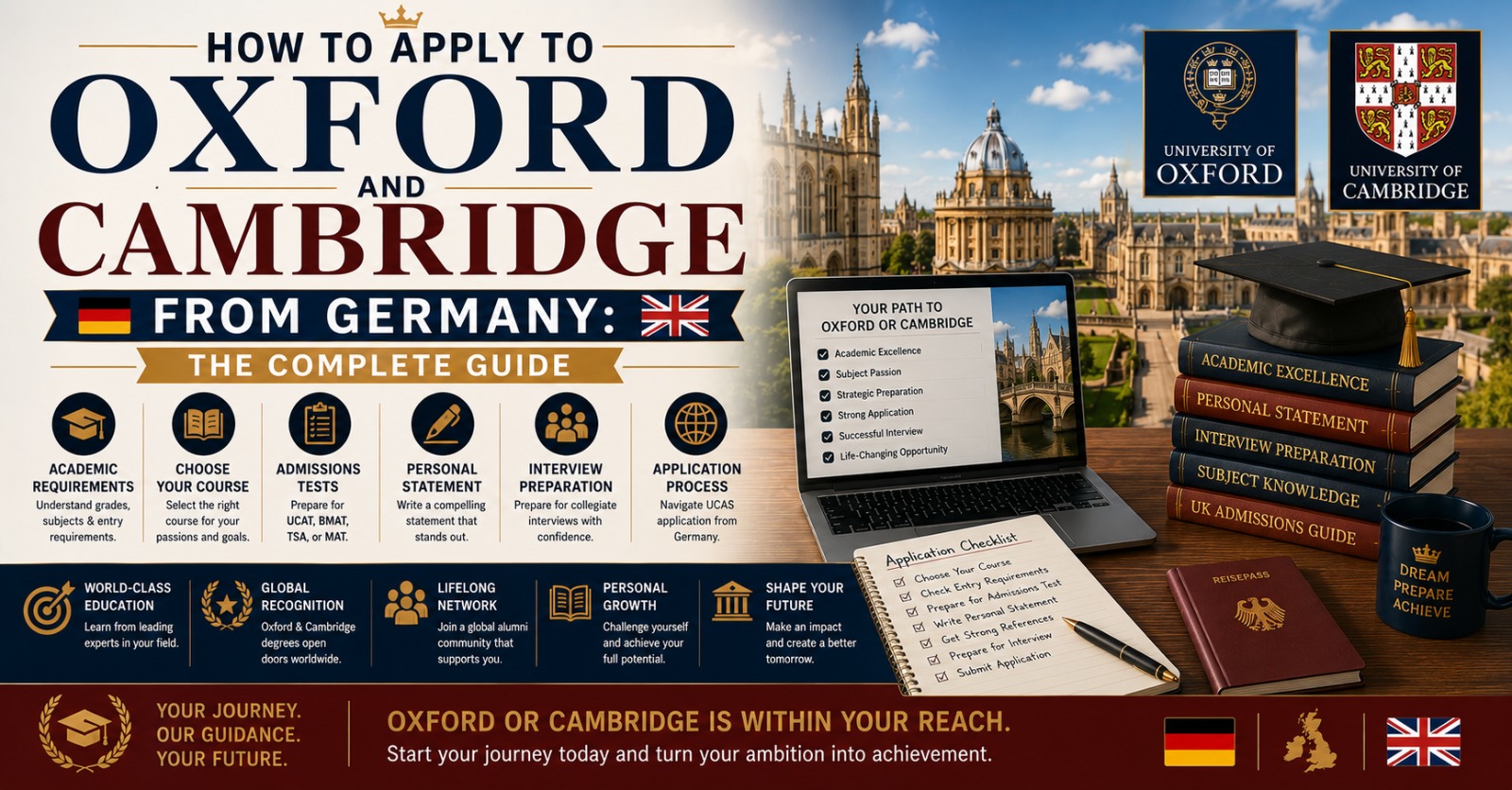
Oxford and Cambridge are among the most academically prestigious universities in the world. For students at international schools in Germany considering these institutions, the most important thing to understand from the outset is this: the UK admissions process is completely different from the US process.
No CommonApp. No personal essay about who you are as a person. No SAT or ACT. Instead: UCAS, subject-specific admissions tests, and at Oxford and Cambridge, rigorous academic interviews designed to test how you think in real time. This guide explains everything you need to know.
Hinweis: QUICK REFERENCE: Oxford acceptance rate: approx. 14-17% — Cambridge: approx. 18-21% — Higher than Ivy League but highly subject-selective — UCAS deadline for Oxford/Cambridge: October 15 — Personal Statement: 4,000 characters, academically focused — Admissions tests: required for most subjects — Interviews: nearly all Oxford/Cambridge applicants are interviewed
Oxford vs Cambridge vs LSE — Key Differences
| University of Oxford | Rate: approx. 14-17% — Tutorial system — strong in Humanities, Law, PPE, Sciences |
| University of Cambridge | Rate: approx. 18-21% — College system — extremely strong in Sciences, Mathematics, Engineering |
| LSE (London School of Economics) | Rate: approx. 8-12% by programme — world-leading in Economics, Politics, Social Sciences |
| UCL | Rate: varies widely by subject — very strong in Medicine, Law, Engineering |
| Imperial College London | Rate: approx. 14% — world-leading in Sciences, Engineering, Medicine |
| Russell Group | Group of 24 leading UK research universities — the UK equivalent of the Ivy League |
How UCAS Works — The UK Application System
UCAS (Universities and Colleges Admissions Service) is the UK equivalent of the Common Application. You apply to up to five British universities simultaneously through a single application.
| UCAS website | ucas.com — registration and application online |
| Maximum applications | 5 universities or programmes simultaneously |
| Oxford or Cambridge | You may apply to only ONE of the two — not both in the same cycle |
| General UCAS deadline | 31 January for the main round |
| Oxford and Cambridge deadline | 15 October — nearly three months earlier than other universities |
| Medicine deadline | 15 October for all UK medicine programmes |
The UCAS Personal Statement — Completely Different From the US
This is the most important difference from the US admissions process: the UCAS Personal Statement (4,000 characters) is NOT a personal essay about who you are as a person. It is an academic motivation letter about why you want to study this specific subject.
| Length | 4,000 characters including spaces — approximately 500-600 words |
| Focus | 80-90% academic: why does this subject interest you? What have you read, researched, explored? |
| Personal element | 10-20%: relevant extracurricular activities that connect to the subject |
| What it is NOT | Not a CommonApp essay about your childhood, personality or family situation |
| Same for all universities | The same UCAS personal statement goes to all 5 universities — no university-specific supplements |
| Language | Always in English |
Hinweis: For IB students in Germany: the IB Extended Essay and Theory of Knowledge are genuinely valuable material for UCAS personal statements — they demonstrate the kind of independent intellectual engagement that Oxford and Cambridge specifically look for. Reference your Extended Essay subject and what you discovered through it.
Admissions Tests — What You Need to Know
Almost all degree programmes at Oxford and Cambridge require additional subject-specific admissions tests. These are taken separately from the UCAS application and form a critical part of the selection process.
| TSA (Thinking Skills Assessment) | PPE, Economics, Psychology, Geography — Oxford and Cambridge |
| MAT (Mathematics Admissions Test) | Mathematics and related subjects — Oxford |
| STEP (Sixth Term Examination Paper) | Mathematics — Cambridge |
| PAT (Physics Aptitude Test) | Physics and Engineering — Oxford |
| HAT (History Aptitude Test) | History — Oxford |
| LNAT (Law National Admissions Test) | Law — Oxford, UCL, Kings College and others |
| BMAT (Biomedical Admissions Test) | Medicine — Oxford, UCL, Imperial |
Hinweis: For students in Germany: most of these tests can be taken in Germany at authorised test centres in major cities. Check the specific test requirements for your subject on the Oxford or Cambridge admissions website early — some registration deadlines fall in late September.
The Oxford and Cambridge Interview — What It Actually Is
The Oxford and Cambridge interview is unlike any other university interaction you may have encountered. It is not a personality interview. It is an academic thinking exercise conducted in real time.
Typical format: you are presented with a question from your subject area — often one you have never encountered before. You are then asked to think through it out loud. The tutors do not primarily want to see that you know the right answer. They want to see how you think when faced with something unfamiliar, under pressure, with an expert audience.
- Mathematics interview: Take this problem and think through it out loud — even if you do not immediately see the solution
- History interview: Read this document in three minutes and tell me what you think about it
- Philosophy interview: Is it possible to think about nothing?
- Physics interview: Estimate how many piano tuners there are in London
Hinweis: The Oxford/Cambridge interview cannot be prepared for like a school exam. What can be prepared: getting comfortable thinking out loud, asking questions when something is unclear, and treating uncertainty as productive rather than threatening. Mock interviews with someone who asks genuinely unfamiliar questions are the most useful preparation.
Your Qualifications — Abitur and IB at Oxford and Cambridge
| German Abitur | Fully recognised. Oxford and Cambridge typically expect an overall average of 1.0-1.3 plus 14-15 points in relevant Leistungskurse |
| IB Diploma | Oxford typically expects 38-40+ points with 7s in relevant Higher Level subjects. Cambridge similar. |
| A-Levels | A*A*A or A*A*A* for most competitive Oxford/Cambridge programmes |
| Language requirement | If German is your first language, some programmes require proof of English proficiency (IELTS 7.0+) |
| Subject alignment | Your chosen Leistungskurse or IB Higher Level subjects must align with your intended degree subject |
USA vs UK — Which Is the Right Fit?
| If you are not yet certain what you want to study | USA — Liberal Arts allows exploration in the first 1-2 years |
| If you know exactly what you want to study | UK — 3-year specialisation is more efficient |
| If campus life and community matter to you | USA — broader campus culture and more diverse extracurricular life |
| If academic intensity is your priority | Oxford/Cambridge — intellectual rigour is unmatched |
| If reducing cost is important | UK — 3 rather than 4 years, often lower living costs than US |
| If you need generous financial aid | USA — Harvard/Yale/Princeton cover 100% of need for international students; UK aid is more limited |
Can I Apply to Both Oxford and Harvard?
Yes. There is no restriction on applying to both UK and US Universities simultaneously. Oxford’s deadline is October 15, Harvard REA is November 1 and Harvard Regular Decision is January 1. You can apply to Oxford (October) and Harvard (November) in the same cycle. The only restriction is that you can apply to only ONE of Oxford or Cambridge — not both.
Frequently Asked Questions
Do I need IELTS or TOEFL for Oxford as a student in Germany?
Students with evidence of strong English — such as IB students who have studied in English throughout, or Abitur students with English as a Leistungskurs and a high score — are often exempted from the formal English language test requirement. Check the specific conditions on the Oxford or Cambridge admissions page for your subject.
Is LSE harder to get into than Oxford?
For Economics and related subjects, LSE has some of the lowest acceptance rates in the UK — in some programmes below 8%. Oxford Economics accepts approximately 10-12% of applicants. Both are extremely competitive, but the selection process differs: LSE does not typically conduct interviews while Oxford does, and Oxford requires the TSA test for Economics.
What happens if I apply to Oxford and get rejected — can I still apply to Cambridge the same year?
No. If you apply to Oxford in the October UCAS round and are unsuccessful, you cannot switch to Cambridge in the same application cycle. The restriction applies within the same year. You can apply to Cambridge the following year. This is one reason why the choice between Oxford and Cambridge — if both are genuinely in consideration — needs careful thought before the October deadline.
2 responses